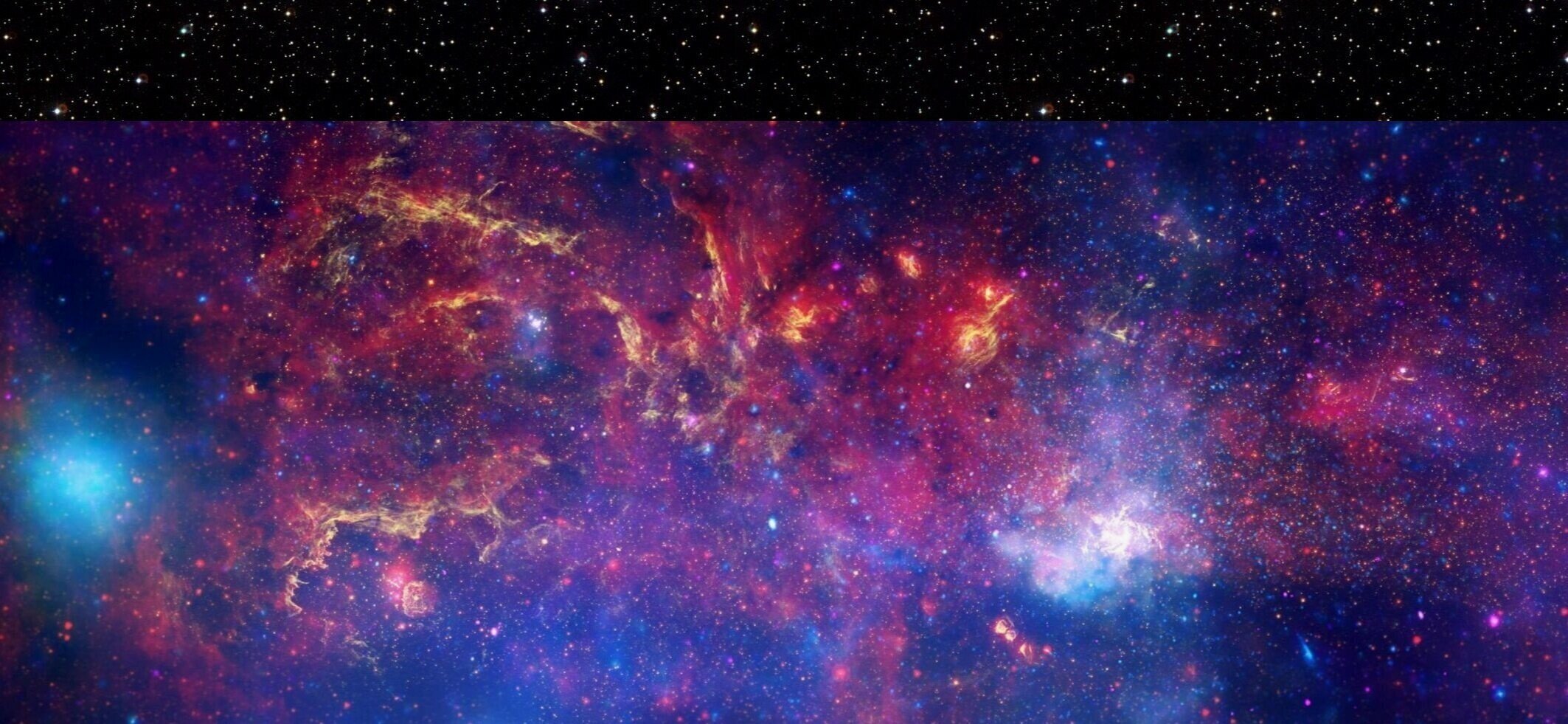
What do you suppose is out there?
September 22, 2008 on 1:07 pm | In Life, Q & A, cosmology |
Reader Gregory Kearney Lawson writes in and asks one of the deepest and yet simplest questions anyone can ask about the Universe:
What is your opinion of life on other planets?
It seems to me that it would be strange to think that life cannot exist on other planets or solar systems.
So how likely is it that other planets in the Universe have living organisms on them? Is Earth probably the only one, or are there many other worlds that are as varied and interesting as our own?

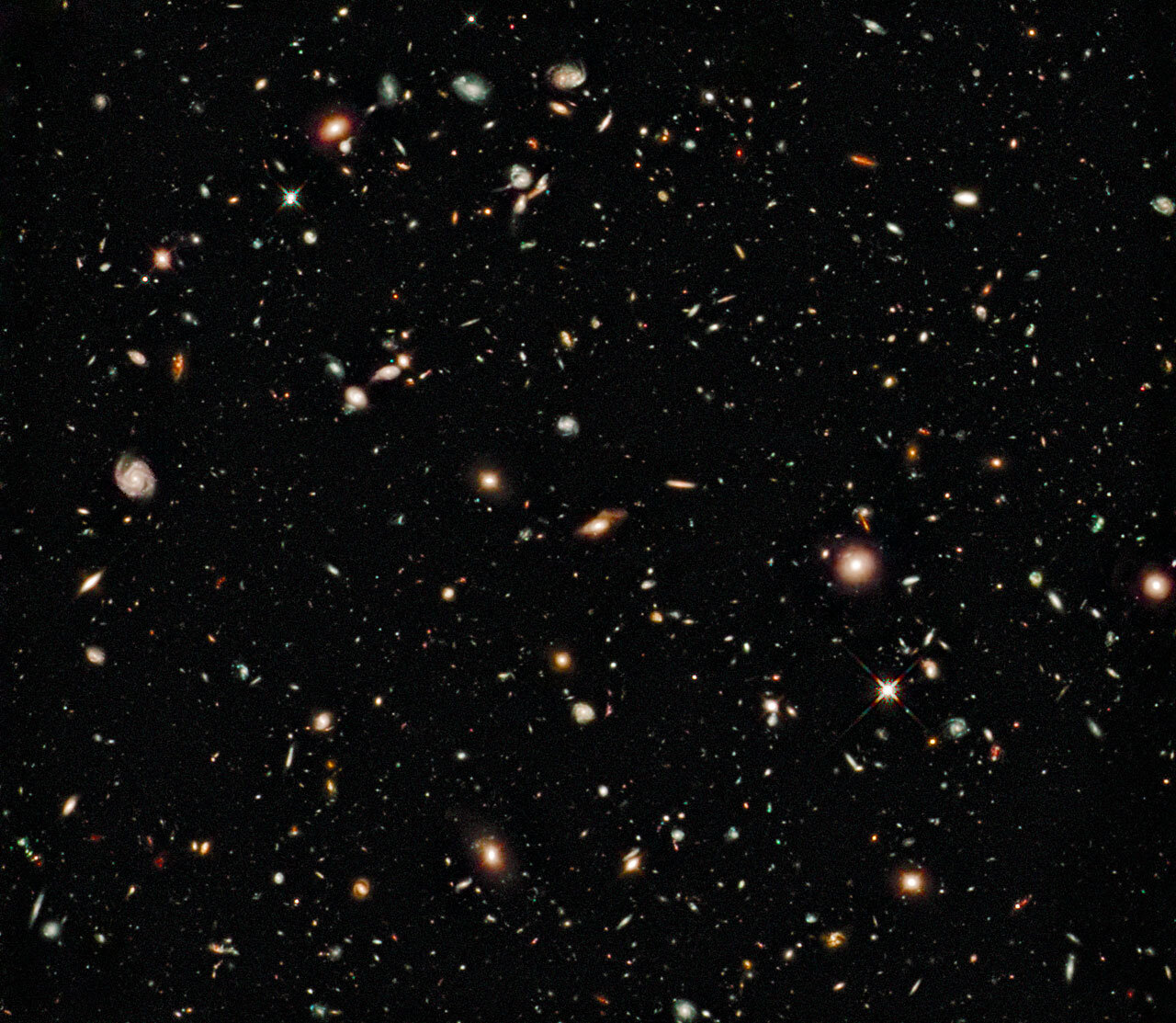
Let’s start by asking a simple question: how many stars are there in our galaxy?
We know the answer is roughly 400 billion stars, even though there may be, realistically, as few as half or as many as double this number. What’s interesting is that about 90% of all of the stars in the Milky Way are relatively cool and small, like our Sun (types F, G, K, and M below). Most are a little smaller (something like 80% are only a fraction of the Sun’s mass), but there are plenty of stars that are very comparable to the Sun in mass, brightness, and composition.

This means that of the 400 billion stars in our galaxy, about 10% of them are similar enough to our Sun that they could reasonably have planets around them that support life. This means our galaxy has about 40 billion chances to have another planet like Earth in it.
So the next step, now that we know how many good stars there are, is to ask how many of them have planets that could support life on them? It turns out, as far as we can tell, that most stars actually do have planets orbiting them. Although we’ve only discovered about 300 planets orbiting other stars at last count, the results are consistent with the majority of stars having planets orbiting them. Due to limitations in the technology we currently have, we’ve only been able to find gas giant planets around other inhabitable stars, but when I say we’ve been able to find them, we’ve actually been able to optically image them. In fact, here’s the very first one, which weighs in at 8 times the mass of Jupiter:

But we have found rocky planets, and we have found planets around inhabitable stars, and they all seem abundant. The question is how many planets, in each Solar System, will be within what we call the habitable zone, or in the region around the star where they won’t freeze or be cooked? Well, our Solar System had, at its outset, three chances: Venus, Earth, and Mars. Currently, Earth is the only one with life, but Venus and Mars may both have had it in the past.

You can read more about habitable zones here, but the overall lesson is that it’s very easy to have a rocky planet in the area around a star where, at some point, you can have life, such as Mars or Venus. It’s more difficult to have a planet like Earth, where the temperatures have been just right to allow life to form and evolve for a continuous period of over 4 billion years. As far as I can tell, to have a rocky planet that falls somewhere in the habitable zone at some point happens frequently: maybe 5% of the time according to simulations. On the other hand, to have something Earth-like, which is the right mass to have a living core (and hence be volcanically active), has a magnetic field, has a thick (but not too thick) atmosphere, and is in the continuously habitable zone, happens far less frequently. I don’t know the geophysics to predict volcanic activity, rotation speed, and magnetic fields, but I can predict the rest: we get a planet of the right mass and right atmosphere in the perfect “goldilocks” location maybe 0.01% of the time. Still, this gives us a lot of chances. Out of the 40 billion roughly Sun-like stars, this means about 2 billion have rocky planets that could support life at one time, and there are about 4 million planets in the galaxy with favorable masses and locations as compared to Earth. If we want to be conservative, we can say that maybe only 1 in 4 of those has the right magnetic field and rotation to allow life to evolve, so that leaves us with 1 million good-looking planets for continuous life in the Galaxy.

But then what? Just because all the elements are in place doesn’t mean we’re going to get life, does it? Unfortunately, this is the part where I have to make like OJ’s judge, Jackie Glass, and say “I don’t know.”

I don’t. Given something as perfectly positioned as the Earth a million times, how many of those times will we form life? Once? A hundred times? Ten thousand times? All one million? I don’t know; we don’t even know whether Mars and Venus once had life, or whether any of Jupiter’s or Saturn’s moons did. And then of those, if we do form life, how many of those will eventually evolve into intelligent life, at least, as we define intelligence? 10%? 0.1%? Or is this something extremely rare: will we not only be the only intelligent species in the galaxy, but in the whole Universe? I don’t know, and I’m not alone; nobody living yet does.
If we can learn from the history of apex predators, though, we’ve got about a million years on top, to develop technology and spread our wings, assuming we get through the crises of destroying ourselves and our planet. But I think it’s very likely that there’s life in our galaxy, there’s intelligent life in the Universe, and that it’s our duty to survive long enough to find it, and find the answer to this mystery about whether we’re alone in the Universe or not.

And, of course, if you haven’t caught it yet, Carnival of Space #71 is up at a new astronomy blog, dotastronomy. Check it out!
13 Comments »
RSS feed for comments on this post. TrackBack URI
Leave a comment
Entries and comments feeds. Valid XHTML and CSS. ^Top^ Powered by TopSoftware4Download.com with a personally modified jd-nebula-3c theme design.

I think you need to also consider position in the galaxy. We seem to be in a very quiet area, too close to the energetic center or a star whose orbit loops thru energetic areas would not be hospitable for life. Being near a pulsar or other unpleasant neighbor would not do either.
Comment by agesilaus — September 22, 2008 #
Agesilaus,
There’s actually a lot of debate going on about that. A number of people agree with you, but there is no consensus; the idea of a “galactic habitable zone” is controversial, to say the least. Personally, I think that if our magnetic field can protect us from *our* Sun, there’s a good chance it can protect us from particles coming from light-years away.
Comment by ethan — September 22, 2008 #
You should have mentioned that the analysis you laid out was first popularized by Drake in the form of the famous equation that bears his name:http://en.wikipedia.org/wiki/Drake_equationHere is a video of Carl Sagan explaining the Drake Equation.One thing that kind of annoys me in most estimates like this is that people assume we’re only considering life in our galaxy. There are billinos of galaxies, which greatly increases the chances for life to exist out there.
Comment by Brian — September 23, 2008 #
Brian,
Although Drake did not invent this line of reasoning, the Drake equation that you reference is one way of trying to estimate the number of intelligent civilizations and the chance of contacting one.
There are something like 1011 or 1012 galaxies out there, but with the exception of possibly Andromeda, how would we ever contact them?
Comment by ethan — September 24, 2008 #
Ethan,
Nice article. I too like to ponder the question about the chance of life elsewhere. And as Brian pointed out, even if we’re the only intelligent life in this galaxy, there’s a high probability that life exists elsewhere, in my opinion. But you’re question as to how would we ever contact them: is that really relevant in determining if life exists or not? We can get proof of life on another planet without having to make contact, right?
And switching topics to what makes a planet ideal for intelligent life to evolve: is having an active geology a requirement for evolution (intelligent or not)?
In support: isn’t the only reason mammals now rule because the dinosaurs vanished very quickly? I presume the answer is yes, but just want to put it out there that there’s maybe a relation between the geology of the planet and the chance for life to evolve.
Comment by Jahmin — September 25, 2008 #
Jahmin,
The nice thing about if it is in our galaxy is that we can confirm and/or find it. If it’s extragalactic, it may exist, but how would we ever know or find out?
An active geology certainly helps, as we can see from our planet. But as for whether it’s required? I’m not sure, either. Brian is a geologist, so he may have an opinion on this that’s more informed than mine.
Comment by ethan — September 25, 2008 #
Jahmin,
Current theories on the origin of life assume that it needs water, an energy source, and a stable enough environment for it to thrive and evolve. We don’t really know if life has to have water, but until we find out otherwise, that’s the working hypothesis.
The energy source can be the sun if you’re talking about photosynthesis, deep sea thermal vents, certain rocks/minerals, or a myriad of other combinations of chemical/thermal gradients. We think planets with active geology (volcanism, plate tectonics, etc.) have warm enough interiors to provide some of these energy sources. However, it’s not inconceivable that life could evolve on a geologically dead planet as long as it got its energy from somewhere (like the sun).
The third item relating to the stability runs the gamut of where the planet sits in the solar system in relation to the sun (the so-called “Habitable Zone”) to how stable its climate is. This would also include how stable a place such as deep sea vents or other such “extremophile” environments are over the long term. Small planets like Mars may have had favorable conditions at one time, but their small size means they lose heat rapidly, and geologic processes that can provide gradients needed by life could shut down before life gets a chance to evolve.
Your dinosaur vs. mammal question is a good one. I don’t think we know for sure what might have happened if the large dinosaurs hadn’t died off. (They all didn’t; that’s why we have birds and alligators today.). It’s pretty clear that the climate was cooling before the famous impact occurred 65 million years ago. Dinosaur numbers were already on the decline when the extraterrestrial disaster struck, so they might have gone away due to environmental pressures. If dinosaurs went extinct more slowly, I could hypothesize that the evolution of mammals might have taken longer, but it probably would have eventually taken place. There is a repeating pattern in history of large species succumbing to environmental pressures while smaller, more adaptable creatures can survive.
Comment by Brian — September 27, 2008 #
Surfing through the web I found this link and to my surprise I am happy to find out that my question regarding life in space has started this debate.
According to the analisis done here there are approximately 1 million planets with perfect conditions for supporting life as we know it.
It seems to me that with this information the burdon of proof would be carried by the ones believing that there is no life on other planets because it is more probable that there is life other than on the planet earth.
Until today we believe that life must need certain elements and conditions but that does not mean that there can be different forms of life that use other elements other than oxygen, water etc.
This increases the chances of there being life on other planets a lot more than one million times.
Even on our planet, plants for instance breath oxygen during the day and give off carbon dioxide, but during the night the process is inverted.
In short it would be very egotistical to think that we are the only planet in the universe that has life, although some life forms that are still not so intelligent, lol
Lic.Gregory Kearney Lawson.
http://attorneykearney.com
costarica@attorneykearney.com
Comment by Lic.Gregory Kearney Lawson — October 14, 2008 #
Who first made the discovery of these plants and who really knows how this whole universe thing started?Because many people believe that GOD did all this,now why do we qeustion what GOD has done by sying this started over a big bang.
Comment by Thanduxolo — March 2, 2009 #
A piece of mathematics I read in an aold b-rate book i read (and kept), “The Planets Beyond”.
It contained a formula that predicted the position of each planet. It shows where each planet should be, and gets each fairly accurate, except for one. It predicted there would be a plnet between Earth and Mars, roughly where the asteroid belt is.
I am always surprised the formula doesn’t come up in predicting the position of planets around other suns when the position of is known.
My 2 cents worth.
I’m almost certain this is the book:
http://www.amazon.com/Planets-Beyond-Discovering-System-Astronomy/dp/0486436020/ref=cm_cr_pr_product_top
Comment by Liam Scanlan — September 5, 2009 #
The Bible says that WE HAVE COME SHORT FROM THE GLORY OF GOD. MY MEANING IS THAT, DUE TO “SIN” WE CAN NOT SEE MANY THINGS WHICH WE DESIRE TO SEE. I do beleive there are THINGS IN many planets! Why are there UFO? Moreover we find no records of them harming us. Thereafter A friend of my a truck driver said He was stoped by a UFO and they put some thing(Glass looking I believe a track device) in his left arm. They told him to tell no one. I did my best but he did not speak of which. Just believe GOD, Go to heaven and we shall find this out. Nevertheless The Bible did say HE (GOD) made humans 6000 years ago yet it does not say He made the Earth 6000 years could be millins or bilions of years befoer He made us. He made the heaves and the Earth, the eart was void, I can go on all day yet I will end here. FEAR GOD AND LIVE AND SEE ALL WE DESIRE -THANKS
Comment by Jones — November 14, 2009 #
hi there
Comment by christine — November 23, 2009 #
i would love to see a planet that has life. but i now in my life time i will never get to see it but there are some things in life that the human race and i will never under stand. and if people would stop believeing in god then we can exceed in life if we try to find the answer instead of believeing god and just leaving it at that. then one day we will evolve into something grater than god. so drop the bible and go and find out how it really works and see the truth of everything. THINK ABOUT IT!!!!!!!
Comment by lucas — February 22, 2010 #