Big News about Black Holes!
May 16, 2008 on 10:56 am | In black holes | 2 Comments
This has been all over my inbox since the press release came out yesterday; it’s been on slashdot (thanks Brian), it’s been at space.com, and there’s a mediocre writeup on Universe Today. What’s the big news? Black Holes don’t destroy information after all!
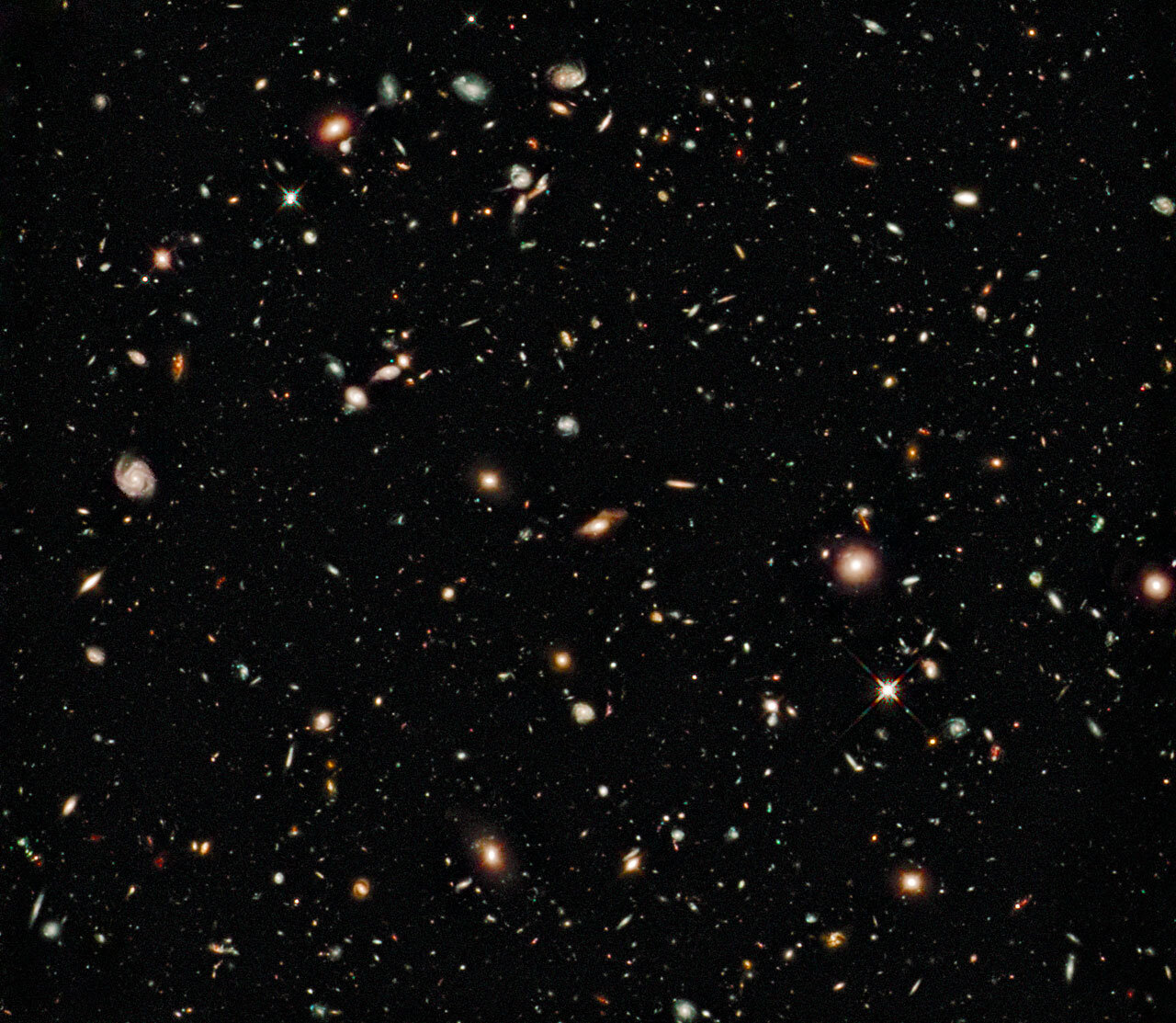
What is this whole information thing, anyway? Take a look at all the normal stuff in the Universe: photons, protons, neutrons, and electrons, for example. They have lots of different properties each. They move around one another, they get bound and unbound from one another, they exert forces on one another, etc. They’re aware of one another, and they interact with one another, and they have many properties, both intrinsic and extrinsic. And when they come together, they make complex things, like atoms, which contain even more information than the individual particles do on their own:

But when you put all of this stuff into a black hole, all of this information seems to disappear. Black holes have only three properties: mass, charge, and spin. Everything else, all the information you put into it, seems to disappear. Doesn’t matter whether you put a bunch of neutrons in, or a bunch of human beings in: to a black hole, they’re the same things. Black holes don’t remember quantum numbers, they don’t remember how many quarks or electrons you put into it. All they care about is mass, charge, and spin.

Or so the story goes. That’s what Stephen Hawking has been saying for years, leading to his famous information paradox about black holes.
Well, it’s a paradox no more! A team at Penn State, led by Abhay Ashtekar (who’s pretty famous for his work on trying to formulate a quantum theory of gravity), has shown how all of that “lost information” can be recovered. The catch?
It means that space-time is not a continuum.

Instead, on the smallest scales, it has to actually be discrete, like little “chunks” of space-time strung together to create a giant mosaic.

The reason for this is that without a continuum, there can’t be any such thing as a singularity. Here’s what Ashtekar had to say about it:
Information only appears to be lost because we have been looking at a restricted part of the true quantum-mechanical space-time. Once you consider quantum gravity, then space-time becomes much larger and there is room for information to reappear in the distant future on the other side of what was first thought to be the end of space-time.
Wow. Now this hasn’t been verified or even published yet (May 20th, in Physical Review Letters), but this is really ground-breaking! Have a great weekend, folks, and don’t forget to swing on over to this week’s Carnival of Space at Altair VI, where you can read about lots of interesting stuff, including how to avoid Armageddon from incoming asteroids!
Pluto has been Melting!
May 15, 2008 on 9:26 am | In Solar System | 2 Comments
Sure, astronomers might not call it a planet anymore, but every schoolchild knows how badass Pluto really is. It’s got a giant moon, Charon, and two smaller ones, Hydra and Nix.

In addition to being colder than ice with an average temperature of 44 Kelvin (that’s colder than liquid nitrogen), I’m here to bring you the news that despite the fact that it’s so cold and so far from the Sun, Pluto has been melting!

Since its discovery by Clyde Tombaugh in 1930, astronomers have been fascinated with Pluto, making very careful observations of it, trying to learn more about this bizarre, icy sphere so far-flung from the Sun. Recently, a team of scientists led by Bradley Schaefer took a look at 75 years of accumulated data on Pluto, and found something incredible.
You see, much like our Moon, Pluto has one hemisphere darker than the other. For our Moon, the side that faces us is darker than the side that faces away:


Astronomers call the difference between the brightness (or reflectivity) of a planet albedo. Pluto’s northern hemisphere has a darker albedo than its southern hemisphere, and that explains why Pluto appeared to get darker from 1954 to the 1980s.

But from 1933 to 1954, we saw the same latitudes of Pluto. Why, then, did it appear to get darker over those times as well?
Some portion of Pluto’s poles, just like Earth’s poles, receive sunlight constantly for months (or in Pluto’s case, possibly years) at a time. They conclude that there must have been a real albedo change by about 5% over Pluto’s southern hemisphere over those 21 years. And their best explanation is that since Pluto has a very thin atmosphere (made of Nitrogen, just like ours), when one of the poles is continuously exposed to the Sun, the light and heat causes the frost on the poles to sublimate (or boil off directly from the solid phase). Because frost has a different reflectivity than the rest of the reddish Plutonian crust (which is mostly solid methane), that causes the observed change in albedo. And hence, Pluto is melting!
Now, where will the Plutonians go to live? And will we have to wait until the New Horizons mission reaches Pluto in 2015 to find out?

And on the sixth day…
May 14, 2008 on 12:51 pm | In Life, Politics | 2 Comments
Good news for science from… the Vatican? No joke. Father Gabriel Funes, director of the Vatican Observatory and chief astronomer for the Pope, has just issued a public statement stating the following things:
- Intelligent beings could exist in outer space.
- Life on Mars cannot be ruled out.
- The search for extraterrestrial life does not contradict belief in God.
- Next year, the Vatican is organizing a conference to mark the 200th anniversary of the birth of Charles Darwin.
Whoa. And whoa’s wobbly cousin, woah. Did I just step into the 21st century? After my post last week on what Americans don’t know, I was feeling a little disheartened. Now I’m quite heartened again! Let’s recap. We see continual creation of stars all over the Universe:

We find organic molecules on other planets and in other star systems and galaxies:

And now we have the leaders of the Catholic church, hugely influential in the United States, telling us that searching for more information about our Universe is a fantastic thing that they should support!

He stated that no man on Earth has the authority to place limits on what he calls “God’s creative freedom.” You can give it whatever name you want; I choose to call it the laws of Nature, and the freedom arising from those natural processes. Either way, I’m happy to have the support to help search for it! Maybe there’s hope for us all, yet.
Astronomers make use of… molecules?
May 14, 2008 on 10:42 am | In Astronomy, big bang | No Comments
When I think of molecules, I think of Conan O’Brien doing his skit where he plays Moleculo…

the molecular man! I don’t think of astronomy, and I certainly don’t think of the leftover radiation from the big bang (known as the cosmic microwave background)!
But somebody over at the European Southern Observatory put these two together and made an incredibly tasty science sandwich.
See, we can measure the cosmic microwave background today, because we have photons (particles of light) coming at us in all directions at all locations, with a temperature of 2.725 Kelvin. Theoretical cosmology tells us that when the Universe was younger, it was also smaller. Because the expansion of space stretches the photons in it, causing them to lose energy, it means that photons were hotter when the Universe was younger.
But we’ve never been able to measure that, of course. After all, how can you measure the temperature of something in a place where you aren’t? (Hint: read the title of this post.) Use molecules as thermometers! Using a carbon monoxide molecule (CO to you chemists) in a distant galaxy, they were able to measure the temperature of the microwave background when the Universe was only about 3 billion years old! The temperature they measured was 9.15 +/- 0.70 Kelvins; and this compares pretty well with the predicted temperature of 9.315 Kelvin. Not bad! Here’s an incomprehensible graph for you to look at while you take it all in:

What’s nice about this is that, even though it’s just what we expected, it rules out or constraints a lot of crazy alternatives (such as theories where the fundamental constants vary), because the temperature of the microwave background evolves according to standard theoretical predictions. Here’s a link to the actual scientific paper, if you’re into that sort of thing.
By the way, while I’ve got you thinking about astronomy, NASA just announced that their X-ray satellite, Chandra, found a supernova in our own galaxy that went off in the 1800’s, making it the most recent supernova ever to occur in our galaxy! Why’d it take so long to find? Because the whole damned galaxy was in the way: the explosion happened on the opposite side!
How “Quantum” is the Big Bang?
May 13, 2008 on 11:36 am | In Quantum, Scientific papers, big bang | No Comments
There is a very techincal paper this morning by Martin Bojowald that asks the question, How Quantum Is The Big Bang? Let me break it down for you.
If you took a look at empty space and zoomed in on it, looking at spaces so small that they made a proton look like a basketball, you’d find that space wasn’t so empty after all, but was filled with stuff like this:

What are these? They’re little pairs of matter particles and anti-matter particles. They spontaneously get created, live for a brief fraction of a second, and then run into each other and disappear. That’s what happens on very small scales, in the quantum world. (This is known as the Heisenberg Uncertainty Principle, and it actually happens!)
Well, the Universe today is huge. But it wasn’t always; back when the Big Bang was happening, all the matter and energy in the Universe was concentrated into a volume so small that these quantum effects were important!

So now, we can ask the question: how important were these quantum effects at the time of the Big Bang? (FYI: this is talking about what happens at a singularity, so this is even before inflation!) And what he basically found is that at these super-high densities, you start to run into something very interesting. Remember the Pauli Exclusion Principle? It says that no two fermions (e.g., protons, neutrons, or electrons) can occupy the same quantum state. You put all the matter in the Universe into a small enough volume, and you wind up “squeezing” everything together!

And what he found, as best as I understand it, is that the quantum state of whatever’s in the Universe determines what type of Big Bang you get! Is it the same in all directions? Well, that depends on what the quantum state of the Universe is. Will it start expanding, contracting, or oscillating? Again, depends on the quantum state. We don’t know what that state is, especially in the context of inflation (which might wipe out all of that information), but this is what they’re trying to figure out! No definitive answers yet, but at least the quantum gravity people have gotten to the point where they can start to ask this question!
Entries and comments feeds. Valid XHTML and CSS. ^Top^ Powered by WordPress with a personally modified jd-nebula-3c theme design.