adobe photoshop 6 book Adobe Creative Suite 5 Web Premium software download adobe photoshop lightroom crack leagal adobe photoshop software for cheap Adobe InCopy CS5 for Mac software download actualizacion adobe illustrator 10 download adobe acrobat tryout crack Adobe Photoshop Lightroom 3 software download adobe illustrator cs2 12.0.0 crackz serialz adobe acrobat 70 professional free download Adobe Dreamweaver CS5 software download adobe photoshop elements 5.0 scrapbook download adobe acrobat standard Adobe Creative Suite 5 Design Premium software download adobe illustrator demos 5.0 acrobat adobe download free reader Adobe Photoshop CS5 Extended software download adobe illustrator parallogram total training for adobe photoshop cs Adobe Creative Suite 5 Master Collection software download adobe creative suite academic adobe photoshop cs3 mac keygen Adobe Acrobat 9 Pro Extended software download scrolling in adobe illustrator downloading software acrobat adobe form client Adobe Premiere Pro CS5 software download adobe photoshop cs2 filters serial number adobe acrobat 6.0 Adobe Illustrator CS5 software download adobe photoshop killer tips

Rumors abuzz about Dark Matter

September 8, 2008 on 9:10 pm | In Astronomy, Dark Matter |

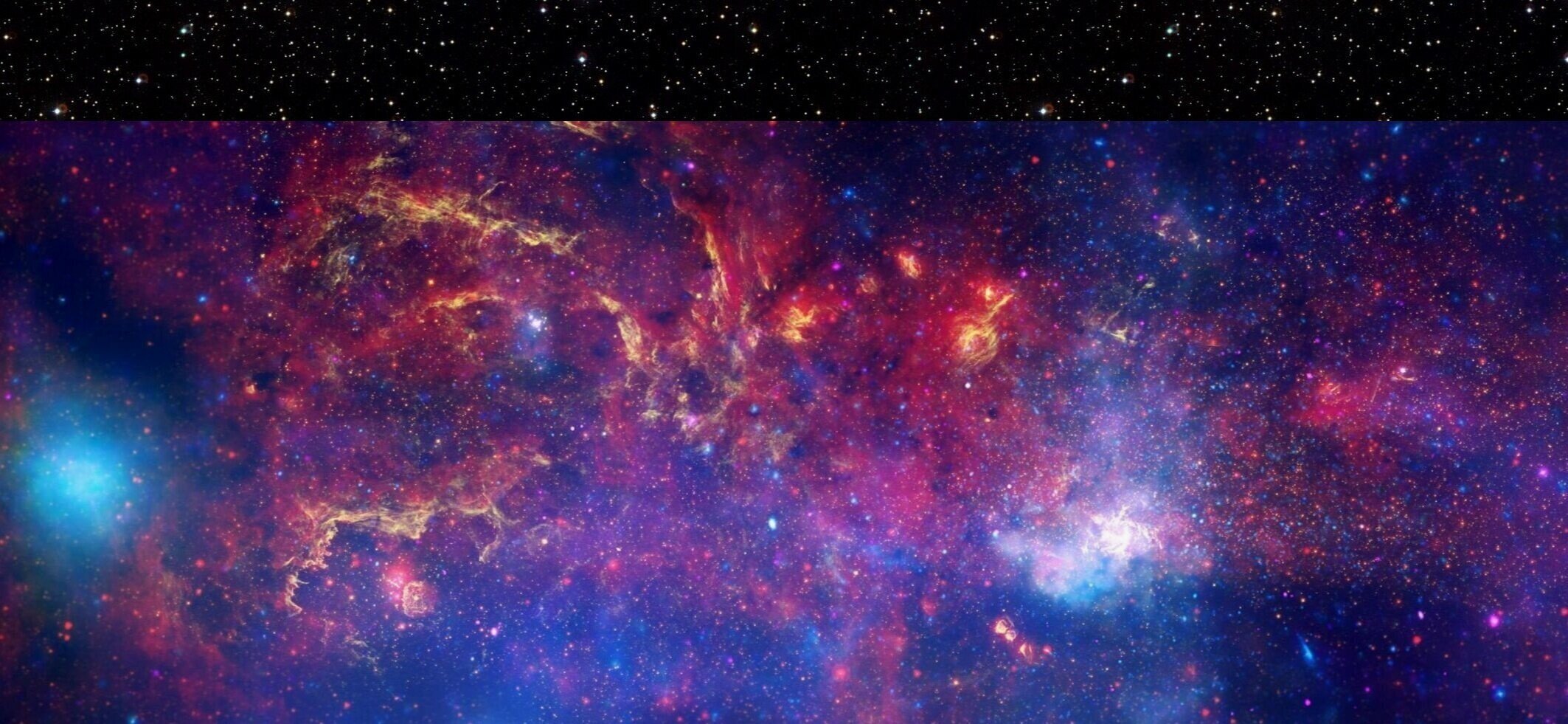
Our galaxy, like just about every galaxy we’ve ever observed, contains a very massive black hole at its center. Take a look!

We know some stuff about it, like its mass (3.6 million solar masses), its near-exact location (see the animation below), the orbits of many stars close to it, and possibly the black hole’s spin, too.

But one thing we don’t know about the galactic center is why there are the number of positrons that there are coming from it. We know there are positrons because like any type of anti-matter, they annihilate with their normal-matter counterparts, which is electrons, in this case. When matter and antimatter annihilate, they produce a special signal: two photons of the exact energy of that particle, as given by E=mc2. For electrons and positrons, this means you’ll see gamma-rays of exactly 511 keV in energy. Do we see them?

Oh, oh yes we do. So something is going on at the galactic center making this anti-matter!

And there have been rumors all over the internet that PAMELA, a detector, may have detected a signature of dark matter in these gamma-ray lines. I’m not on the PAMELA team, and I haven’t seen the raw data (just the preliminary stuff below), but I’m telling you now, don’t believe it so easily.

We don’t know what’s causing these positrons to be created, we don’t understand the galactic center environment well at all, and there are a myriad of candidates, astrophysical candidates for explaining this, without needing to invent a new particle. So it could be dark matter, but I wouldn’t bet on it. And I don’t think you should, either. People have been calling this gamma-ray excess “indirect proof of dark matter” for a long time, most recently with the EGRET team. When you scrutinize the results, however, you see that dark matter cannot explain this. Why not? Because annihilating dark matter should make anti-protons too, and we just don’t see ‘em.

Seriously, even physicists are writing about this like it’s already a great discovery. They don’t see the anti-protons, folks! That’s not evidence!

So when you hear it from somewhere else, take a moment and think about it. We’re scientists, and our standards for accepting things are simply higher than this.


6 Comments »

RSS feed for comments on this post. TrackBack URI

  1. Hi Ethan
    It justs seems that with relativistic speeds of gas and dust spiralling into black hole region allows for enough hot collisions to account for the 511 kev band. I have an idea. Looking into a very small region lessens the probability of dark matter detection while looking at larger emission type objects do allow for it. Why? My conjecture is that dark matter has a ‘Bohr correspondence’ aspect due to the collective effect (of as yet unproven) of the non-observed supersymmetric particles. In other words where you have a tremendous amount of quantum particles that you can see in a large patch the ghostly nature of their supersymmetric counterparts can possibly become observable. These ghostly superparticles would not stick in a collision like normal particles would. So dark matter would be due to the nature of supersymmetric quantum mechanics. The LHC goes on line tommorrow, maybe soon they will discover supersymmetry and this would enliven the supersymemtric dark matter debate.
    Regards, mark

    Comment by mark a. thomas — September 9, 2008 #

  2. Ethan,

    I have 2 questions… 1) Do all black holes produce anti-matter? Simple, I know, but I’m chemist. 2) Why are scale bars added to the photos above? Since the objects in the photo are actually in 3D space the distance between objects would not be those measured in the photo except if you traveled in the focal plane of the image. I guess the better question to ask would be, “What information do you actually get from using the scale bar in those images?”

    Comment by Richard Helmich — September 10, 2008 #

  3. Rich,

    1) All black holes, insofar as they “radiate” matter, radiate equal amounts of matter and antimatter. That’s something we learned from Stephen Hawking, and more specifically, Hawking Radiation.

    2) We can only see a projection on the sky in an image. You’re learning the x- and y- distances from the image, but you’re right, it doesn’t give you the distance in the z- direction. So you get information about 2 of the 3 dimensions, but not the third.

    Comment by ethan — September 10, 2008 #

  4. […] hole at the center of the universe is quite a challenge. Ethan Siegel, at Starts With A Bang!, presents measurements taken by a detector in the gamma-ray domain and why these measurements are up for […]

    Pingback by OrbitalHub » Carnival of Space #70 — September 11, 2008 #

  5. MNyIiI

    Comment by Bqwcxdvi — July 13, 2009 #

  6. 6mxUyh If you have to do it, you might as well do it right.

    Comment by dicloxacil viagra side effects — August 1, 2009 #

Leave a comment

XHTML: <a href="" title=""> <abbr title=""> <acronym title=""> <b> <blockquote cite=""> <code> <em> <i> <strike> <strong>

Entries and comments feeds. Valid XHTML and CSS. ^Top^ Powered by TopSoftware4Download.com with a personally modified jd-nebula-3c theme design.