Dark Matter: More Irrefutable Evidence
August 27, 2008 on 5:29 pm | In Dark Matter, cosmology |
A lot of people don’t like dark matter. It’s a crazy idea, after all. Think about everything in your experience: the skies, the sea, you and me, along with the Earth, the Moon, the Sun, and everything we see.
It’s really beautiful, isn’t it? And yet dark matter tells us that for every atom of normal matter in the entire Universe, there is five times as much dark matter, or matter that isn’t made up of protons, neutrons, and electrons.
How do we possibly know this? Well, all matter has something in common: gravity. No matter what you’re made of, if you have mass, you exert a gravitational force on everything else in the Universe. But if you’re made up of normal matter (remember: protons, neutrons, and electrons), you can also emit light under the right conditions. The Sun does this, for example.
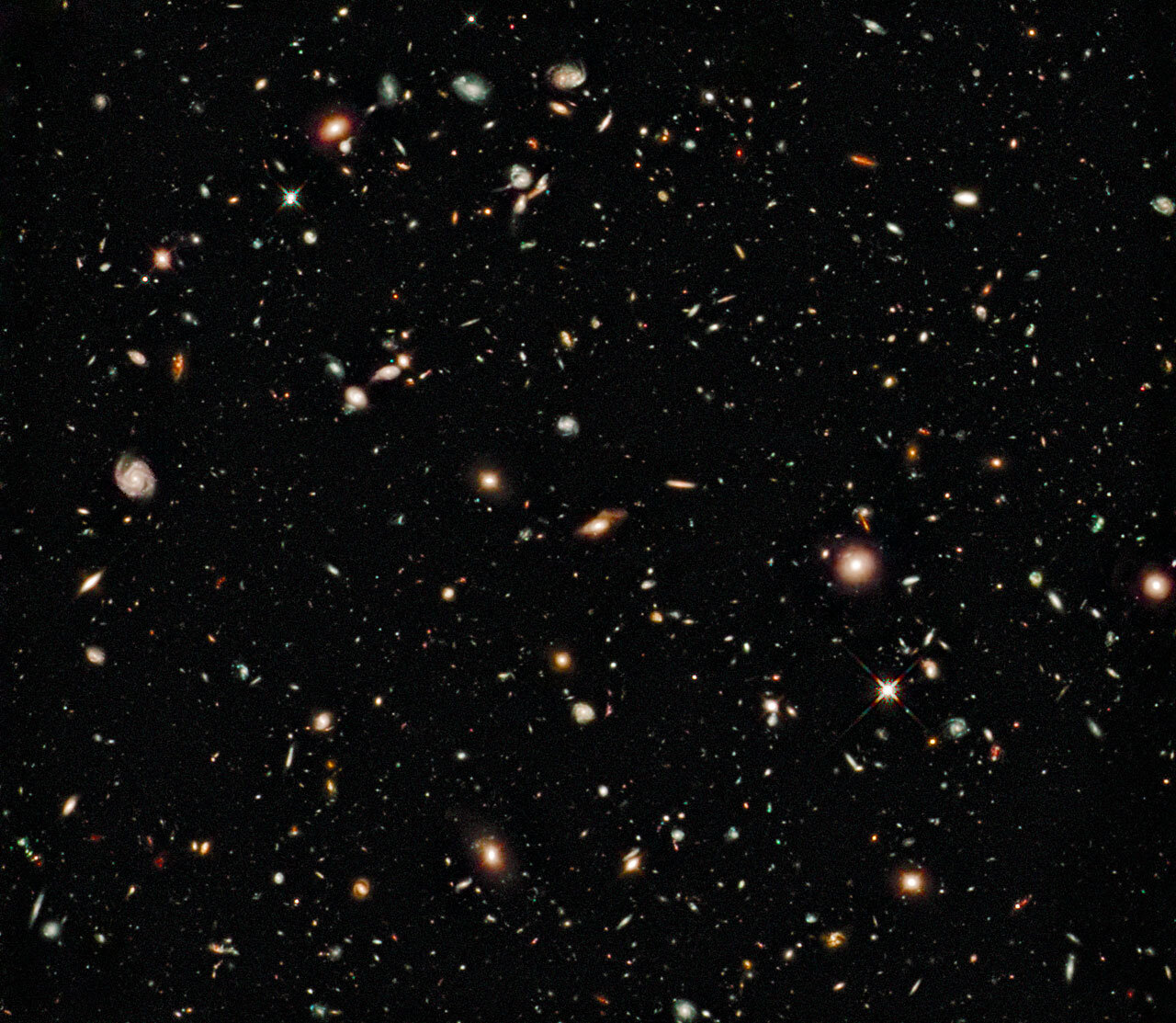
So how can we find dark matter? Let’s take the biggest things in the Universe: clusters of galaxies. These are regions of space that have hundreds or even thousands of galaxies the size of our Milky Way in them, and all told they weigh over a quadrillion times as much as our Sun. It would make a great experiment if we could smash two of them together. Because the normal matter should stick together and heat up, and emit X-rays. But if there’s some other type of matter, something different from normal matter, it should just pass right through everything, right on through the other galaxy cluster, like an object in motion remaining in motion. So we look for two clusters of galaxies colliding:

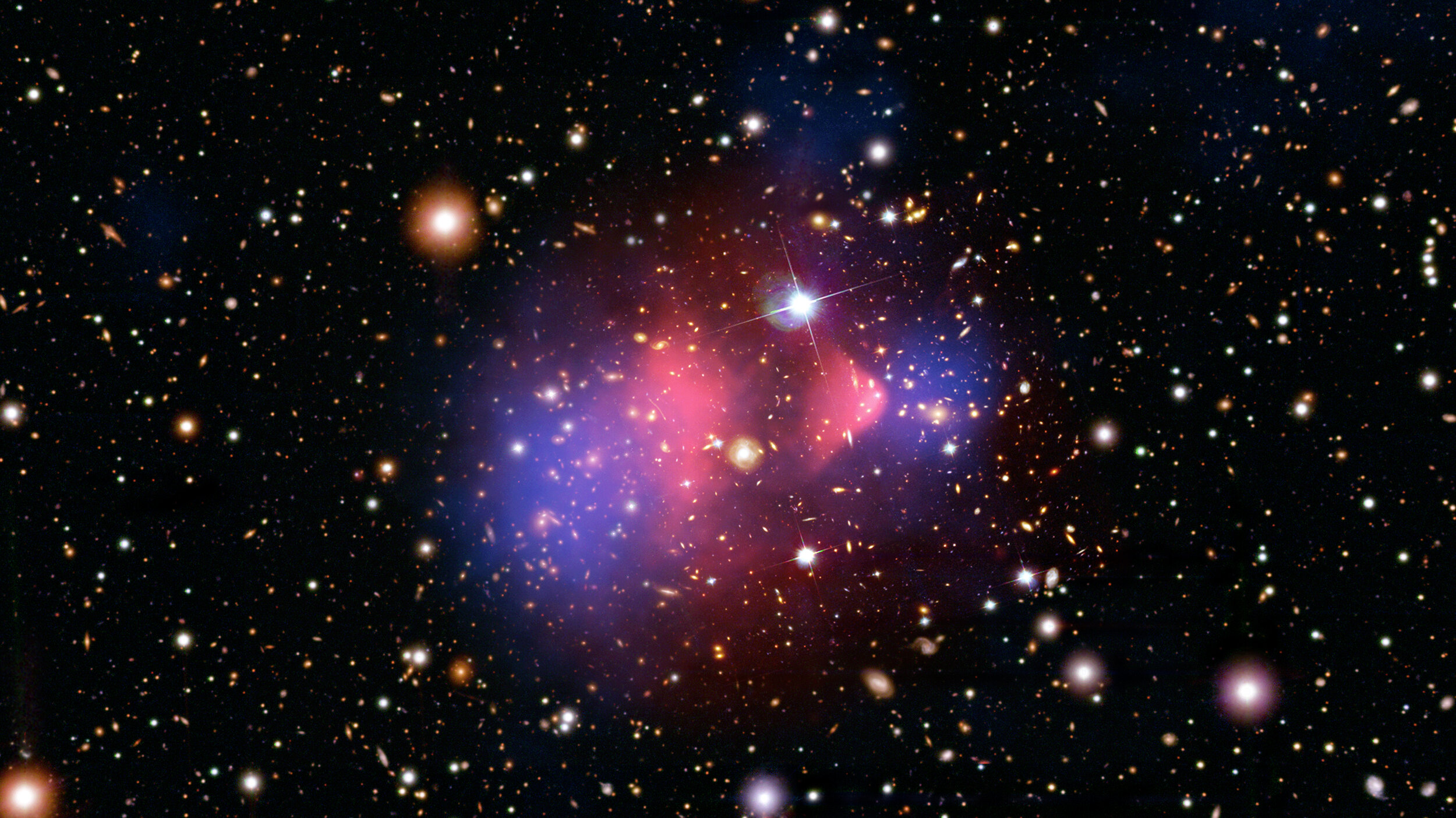
Ladies and gentlemen — BEHOLD! I give you exhibit A, known as the Bullet Cluster. This is two clusters of galaxies colliding, and you can see the individual galaxies here. The pink is the X-ray gas, and you can see that’s where the normal matter collided, stuck together, and emits powerful light in the form of X-rays. But the blue, that’s where all the mass is. From a phenomenon called gravitational lensing, we can measure how much mass there is in a certain region of space. And as you can see, we find that most of the mass is not where the normal matter is.
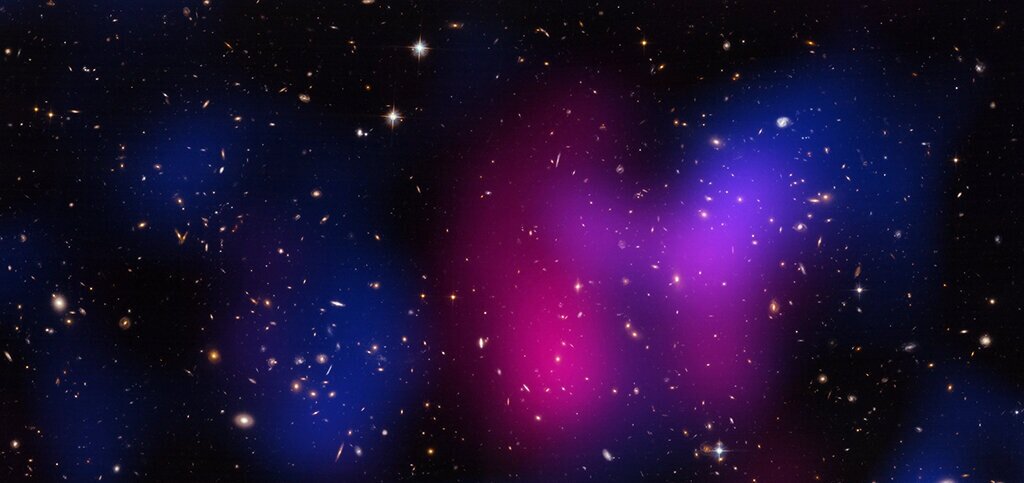
But we are responsible people, us scientists, and we like to have more than one example before we draw a conclusion. And so I offer you exhibit B, cluster Abell 520:

BEHOLD! This is a cluster in the later stages of merger, so that some of the dark matter has had a chance to come back around to their mutual center of mass. Still, the light coming from the normal matter doesn’t trace where the mass is.
So we’re getting close, but can we find an example of this far away? Can we find a very distant cluster that has these same properties? Let’s take a look at a very special cluster: MACS J0025.

Looks like a big honking cluster, and it contains over 1,000 galaxies and weighs in at over a quadrillion solar masses. A big one, for sure. But where is all the mass? Let’s take a look at the gravitational lensing data and see (in blue false color) where it is:

Ahh, it looks like just two lobes, one towards the left of the image and one towards the right. Well, if these were two clusters that just collided, that would be all the matter that just passed through the center. Except normal matter doesn’t do that! It collides, sticks together, and heats up. What if we took our big X-ray observatory, Chandra, and looked at this cluster. Would we see X-rays coming from the middle? Where there’s very little mass?

ha-HA, we do! So when we put all these together, what do we find? Could the normal matter explain all the gravity we see, or do we need something else; some new type of matter? Ladies and gentlemen:

BEHOLD!!! It’s dark matter, different from normal matter, not made up of protons, neutrons, and electrons, but full of mass and exerting a gravitational force nonetheless. There are some awesome animations up at the Chandra Website, which I highly recommend to you.
10 Comments »
RSS feed for comments on this post. TrackBack URI
Leave a comment
Entries and comments feeds. Valid XHTML and CSS. ^Top^ Powered by WordPress with a personally modified jd-nebula-3c theme design.

Still awesome!
But I’m really starting to hate that quadrillion. 1) it doesn’t mean the same over here (long form vs. short form), 2) it’s so big as to be senseless. Not least since we’re talking clusters of galaxies, not stars. The natural metric would be Milky Ways. But I guess that’s problematic since we then have to decide in that’s incl. or excl. dark matter.
The DM and DE deniers (on Univers Today for instance) are also starting to annoy me. DM and DE really are the least loaded names that are still somewhat descriptive, but sometimes I think it woulda been better to go the quark way. Never read Joyce, myself, but perhaps we could go with Tweedledee and Tweedledum or summat.
Comment by Sili — August 28, 2008 #
Sili, although I agree there is completely overwhelming evidence in favour of some additional field in the cosmos which interacts mainly gravitationally I do not think that the case is closed as far as the LCDM picture is concerned. Are cosmologists really sure yet that the need for a small cosmological constant (as \Omega_m=1 is not viable) isn’t ultimately a problem? How big of a problem might it be?
Comment by crowell merryman — August 28, 2008 #
[…] public links >> mutual Dark Matter: More Irrefutable Evidence Saved by livinloud on Wed 22-10-2008 Honeymoon smoothie Saved by SGBOSSMarshall on Fri 17-10-2008 […]
Pingback by Recent Links Tagged With "mutual" - JabberTags — October 23, 2008 #
Dark matter is bullshit. Wake up.
Comment by K — January 30, 2009 #
K,
Thanks for your insights. I disagree with your conclusions, though. Any evidence to support your claims?
Comment by ethan — January 30, 2009 #
I’m doing a project on dark matter and this realy helped.
Thank you!
BC
Comment by B.C. — February 20, 2009 #
GKDVwD
Comment by Myejofxk — July 14, 2009 #
What you are offering here Ethan, is not irrefutable evidence but highly speculative . Your sole ‘evidence’ for dark matter is gravitational lensing evidence which can just as eassily be explained by the gravity of the objects closer to us. Also some of the lensed objects are at right angles to each other and not in a nice circle. What is more some of the ‘lensed’ objects are just unusual shapes that just appear to be lensed. No, I think K above may have the correct answer to your imagined evidence.
Comment by Ian from OZ — September 2, 2009 #
So, we live in a universe where time, space and mass are relative. It’s already been proven right? So what’s more likely, that over 90% of the universe is some invisible material that gravitationally affects galaxies far far away and helps our equations to balance? Or that there are other rules (similar to special relativity) that we haven’t yet discovered that make our equations incorrect?
Think about it.
Comment by doesnt matter — September 21, 2009 #
I love it how in every other field of science, theory is just that, until proven to be “correct”. But in the field of astrophysics, everything seems to stand as fact, as long as you have enough people of your side, until it gets surpassed by the next flavor-of-the-month! Not that I mind, though, it sure makes for good topical discussion!!!
Comment by Tim Heinmann — October 11, 2009 #