adobe photoshop 6 book Adobe Creative Suite 5 Web Premium software download adobe photoshop lightroom crack leagal adobe photoshop software for cheap Adobe InCopy CS5 for Mac software download actualizacion adobe illustrator 10 download adobe acrobat tryout crack Adobe Photoshop Lightroom 3 software download adobe illustrator cs2 12.0.0 crackz serialz adobe acrobat 70 professional free download Adobe Dreamweaver CS5 software download adobe photoshop elements 5.0 scrapbook download adobe acrobat standard Adobe Creative Suite 5 Design Premium software download adobe illustrator demos 5.0 acrobat adobe download free reader Adobe Photoshop CS5 Extended software download adobe illustrator parallogram total training for adobe photoshop cs Adobe Creative Suite 5 Master Collection software download adobe creative suite academic adobe photoshop cs3 mac keygen Adobe Acrobat 9 Pro Extended software download scrolling in adobe illustrator downloading software acrobat adobe form client Adobe Premiere Pro CS5 software download adobe photoshop cs2 filters serial number adobe acrobat 6.0 Adobe Illustrator CS5 software download adobe photoshop killer tips

By PVG viagra

Do all Stars Eventually Explode?

April 7, 2008 on 9:47 am | In Astronomy, Hubble |

What’s going to happen to all the stars in the Universe as they get older? Well, just as nothing can live forever, stars can’t live forever also. Why? Because they run on fuel: burning hydrogen into helium, for example. When they run out of fuel, something’s gotta give. Barbara Ryden reminds us of an excellent and appropriate quote by Dylan Thomas:

Do not go gentle into that good night.
Rage, rage against the dying of the light.

But what exactly happens to the star depends very sensitively on what the mass of the star is.

If you’ve got a tiny little star, less than about 40% of the mass of our Sun, it burns hydrogen to helium, and doesn’t have enough mass to burn helium any further. Our Sun will be able to burn helium into Carbon and Oxygen, and stars significantly more massive will be able to burn Carbon and Oxygen into Neon, Silicon, and even more massive stars will eventually burn those into Iron. Most stars that fall into this category, when they run out of fuel that they’re able to burn, will expand into a giant star, and then contract into a white dwarf.

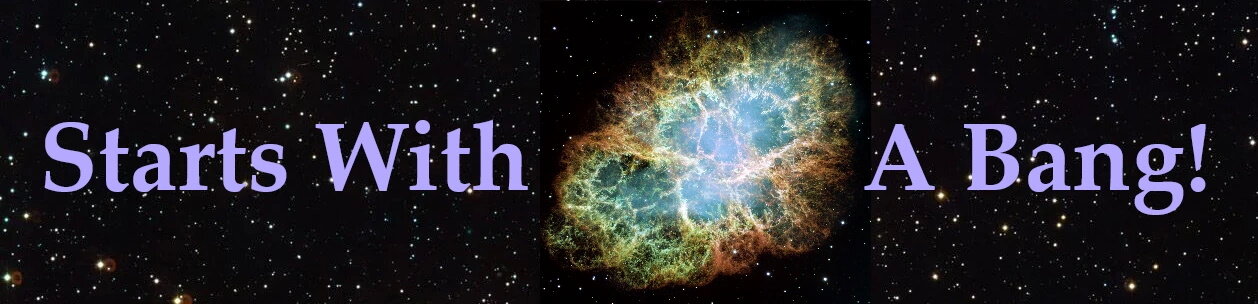
White dwarfs don’t burn anything, and are only “white” because they emit light due to the energy released from contracting gravitationally. (For a size comparison, the radius of Earth is 6371 km.) When they’re done shrinking after a few billion more years, they stop emitting light, and become known as black dwarfs. But the most massive stars with iron cores, about 8 times the mass of the Sun or more, go supernova. When they start to contract, the pressure on the iron core becomes so intense that it starts to fuse the protons and electrons found in the iron atoms into neutrons! This causes a tremendous release of energy, known as a supernova explosion:

If the star is even more massive, the supernova can become even more powerful, and is known as a hypernova. Perhaps the most massive stars, dozens or even a hundred times as massive as our Sun, will go hypernova.

But maybe not! Astronomers from Ireland have been tracking exploded stars with the Hubble Space Telescope. They’ve been trying to determine what the masses of stars were before they went supernova, by trying to identify which star it was that exploded. Based on their findings, they’ve found that some stars may be massive enough that they don’t go supernova or hypernova, but instead, when they stop burning their fuel, collapse directly into a black hole! Now this is neat, because in theory it isn’t the most massive stars that do this, since their radii will be large enough that they won’t directly collapse into black holes, but some special mass range. Here’s a diagram I’ve found to illustrate the different possible fates of stars, based on their starting mass:

Now, what I want to know is, will the most massive stars in our galaxy, Eta Carinae, the Pistol Star, and LBV 1806-20, go hypernova when they die, or collapse directly to black holes? It might depend on where they are relative to the Eddington Limit, but for all we’re sure of at this point, it might as well depend on whether they’ve read their Dylan Thomas or not!


7 Comments »

RSS feed for comments on this post. TrackBack URI

  1. iam doing a speach in the class about stars.so i wount to know if star change coulers

    Comment by sigourney — April 8, 2008 #

  2. i will kill u

    Comment by bob — March 18, 2010 #

  3. FREE ITEMS PLIX :D alguem aew joga tibia? obsidia? troco dimdim heheh BR E NOIX PORRA

    Comment by Xicutreva — January 10, 2011 #

  4. a Buildings, architecture, historical sites need wide angle capability to include exteriors of large buildings and tight interiors. Although, as expected, a large digital photo frame will most likely cost more than a traditional frame, they end up providing much more value for your money as well as save a great deal of space.

    Comment by Bethel Neat — April 30, 2011 #

  5. Your own personal knowledge and kindness in taking care of every part was vital.

    Comment by Sheldon Klohe — September 6, 2011 #

  6. Great – I should certainly say I’m impressed with your web site. I had no trouble navigating through all the tabs and related information. The site ended up being truly simple to access. Great job.

    Comment by Harriette Tempest — June 20, 2012 #

  7. Really love the lipstick and matching gloss. ,[url=http://cheapoakleysunglassesfake.weebly.com/#54066]fake oakley sunglasses[/url]

    Comment by qihmacloyo — December 12, 2012 #

Leave a comment

XHTML: <a href="" title=""> <abbr title=""> <acronym title=""> <b> <blockquote cite=""> <code> <em> <i> <strike> <strong>

Entries and comments feeds. Valid XHTML and CSS. ^Top^ Powered by TopSoftware4Download.com with a personally modified jd-nebula-3c theme design.