adobe photoshop 6 book Adobe Creative Suite 5 Web Premium software download adobe photoshop lightroom crack leagal adobe photoshop software for cheap Adobe InCopy CS5 for Mac software download actualizacion adobe illustrator 10 download adobe acrobat tryout crack Adobe Photoshop Lightroom 3 software download adobe illustrator cs2 12.0.0 crackz serialz adobe acrobat 70 professional free download Adobe Dreamweaver CS5 software download adobe photoshop elements 5.0 scrapbook download adobe acrobat standard Adobe Creative Suite 5 Design Premium software download adobe illustrator demos 5.0 acrobat adobe download free reader Adobe Photoshop CS5 Extended software download adobe illustrator parallogram total training for adobe photoshop cs Adobe Creative Suite 5 Master Collection software download adobe creative suite academic adobe photoshop cs3 mac keygen Adobe Acrobat 9 Pro Extended software download scrolling in adobe illustrator downloading software acrobat adobe form client Adobe Premiere Pro CS5 software download adobe photoshop cs2 filters serial number adobe acrobat 6.0 Adobe Illustrator CS5 software download adobe photoshop killer tips

By PVG viagra

A Risk Free and Transparent Option Payday loans payday

Dark Matter: Is it right in front of us?

January 31, 2008 on 3:46 pm | In Astronomy, Dark Matter, Gravity, Physics, Scientific papers |

Last year, I had just finished my Ph.D. studies, and had moved to Madison, WI to teach introductory physics at the University of Wisconsin. I was working on this paper, and when I submitted it, I got a phone call from New Scientist magazine’s space division.

Fast-forward two weeks, and I find this article online, where I got to see my name in print:

Now, scientists led by Ethan Siegel of the University of Wisconsin, in Madison, US, have come up with a new way to potentially reveal blobs of dark matter drifting nearby and perhaps even pin down what it is once and for all.

And I thought to myself, wow, I actually did that! It’s still a neat idea, a year later, as I’ve kept working on it and just submitted another paper extending my work. Let me break it down for you, and tell you what the dark matter might be, and how we might be able to find it.

We know, pretty simply, how stars work. We know how much light they give off, and that’s very closely related to their mass. Brighter stars are more massive; dimmer stars are less so. So when we look at an entire galaxy, what we’re really measuring is all of the light coming from the stars in it. We know, therefore, how to tell how much mass is present in the stars in a galaxy, or in a cluster of galaxies, or in any astronomical object we look at.

But we have a different way of measuring mass as well: we know how gravity works. So we can watch how galaxies rotate,

or we can look at gravitational lensing, and we can measure how much mass is there from gravity. This way, we know how much total mass there is, and we can see how much of it is from stars.

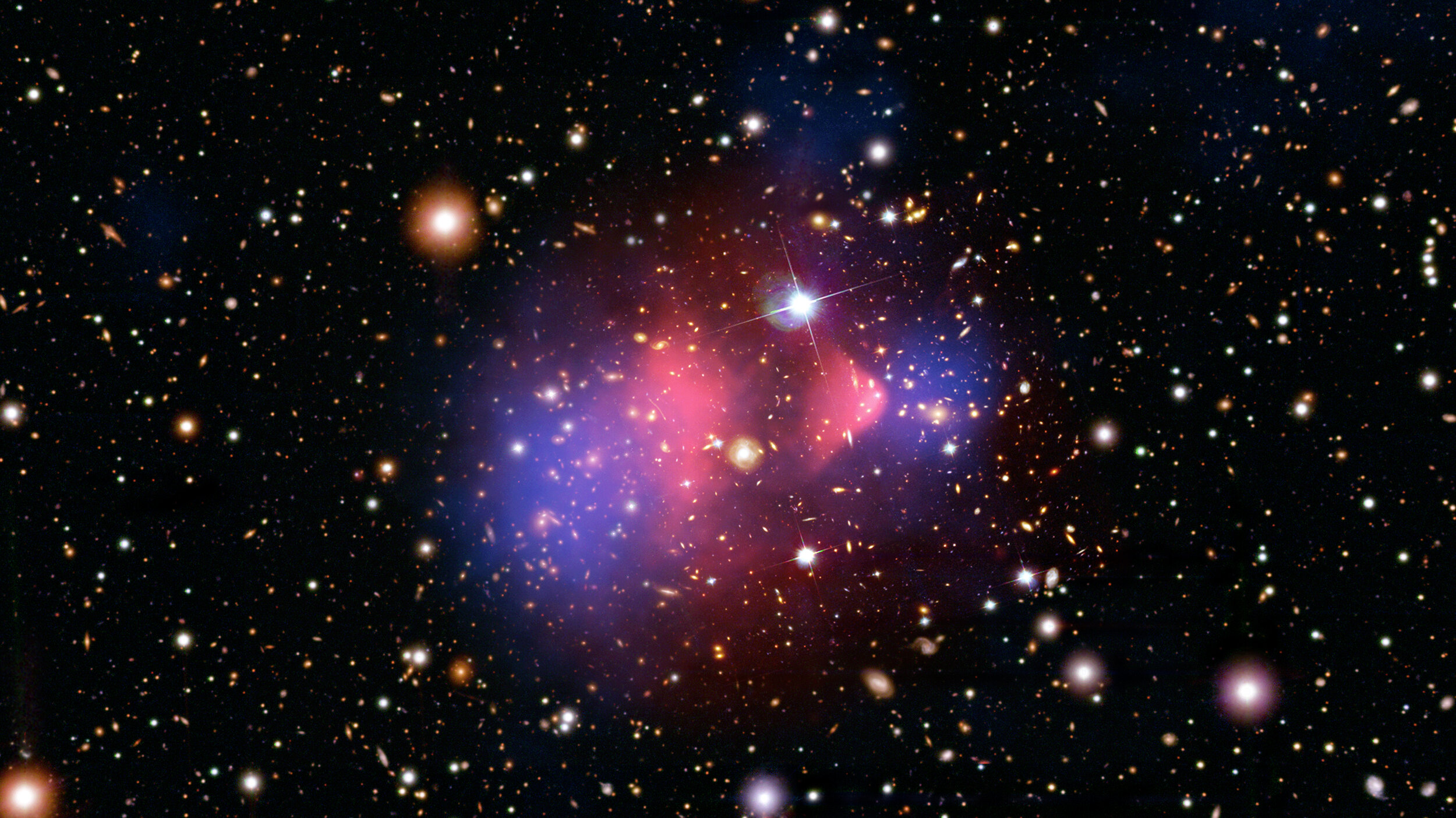
The problem, as you might expect, is that the numbers don’t match up. In fact, what we find is that 98% of the mass is not in stars. Not only is it not in stars, but of that 98%, only about 13% is made up of protons, neutrons, and electrons; we have very little idea what the remaining 85% of the stuff in our galaxy is. So we give it a name, dark matter, since it has mass, and exerts a gravitational force, but doesn’t give off light or interact through any of the other forces. And figuring out what dark matter is will be a nobel-prize-worthy discovery, if we can detect it.

We know from observations that all galaxies have a dark matter halo surrounding them; what we don’t know is whether the halo is smooth, or whether there are clumps of dark matter in them. When we do numerical simulations, though, as well as calculations of different models, we find that they all wind up with clumps in them, like so:

Well, there’s a neat trick we can use to see whether there are these dark matter clumps in our galaxy. When you look out at anything, the light travels to your eye in a straight line. But if there’s something with mass in the way, the mass will bend the light around it according to Einstein’s theory of General Relativity. If the mass is close to the line-of-sight, the bending is more severe; if the mass is far away, the bending is very slight, and the actual position lines up very well with the apparent position, like so:

Well, these theoretical dark matter clumps are too light and too diffuse to cause a visible effect in starlight. But, there are special stars that emit radio light at such high precision that they could see the difference between a dark matter clump being close to it and one being farther away. These stars are called pulsars, and they are so well-measured that the best and fastest of them rotate nearly 1000 times per second (and remember, these are stars weighing as much as the Sun does), and have their periods known to within 10-18 seconds!

So, if we have dark matter clumps in our galaxy, watching pulsars could allow us to find them, since the pulse timing will change as the dark matter clumps move through the galaxy. Right now, the odds aren’t very good because we don’t have enough pulsars, and our radio telescopes aren’t good enough. But if they build the Square Kilometer Array, the odds improve tremendously, so much so that we should detect dark matter clumps if they exist using pulsar timing! If we don’t see them, it means that these halos aren’t nearly as clumpy as we think they should be — either way, this would be the first chance we have to learn anything about the dark matter in our own galaxy!

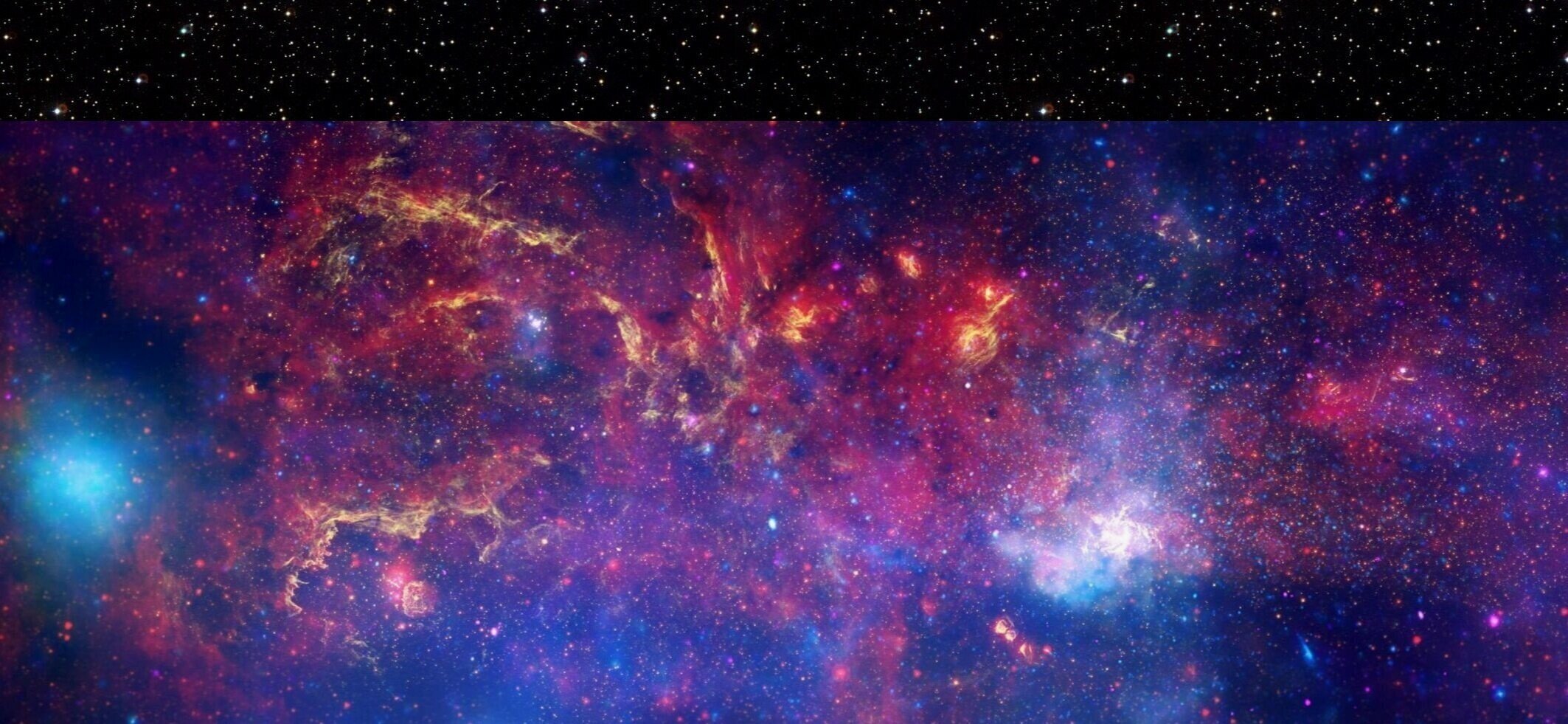
Also, FYI, every week (or so) many of the space-related blogs get together and share their best posts. It’s called the Carnival of Space, and this week my post on visualizing the Milky Way is on it!


5 Comments »

RSS feed for comments on this post. TrackBack URI

  1. kUehbk

    Comment by Bsojdqsc — July 13, 2009 #

  2. For example, after selecting an option you need to remember to set it to activate state. Many times a message appears on your system saying, Cannot find the driver for the operating system.

    Comment by Isaac Airola — April 26, 2011 #

  3. Your own competence and kindness in handling the whole thing was helpful.

    Comment by Elwood Arntzen — September 6, 2011 #

  4. Hi! I could have sworn I’ve been to this site before but after browsing through some of the post I realized it’s new to me. Anyways, I’m definitely glad I found it and I’ll be book-marking and checking back often!

    Comment by Cristin Bucolo — September 9, 2011 #

  5. I definitely wanted to construct a quick remark in order to appreciate you for some of the awesome facts you are writing on this site. My particularly long internet research has finally been paid with wonderful insight to share with my classmates and friends. I would believe that most of us visitors actually are rather blessed to be in a decent place with very many marvellous professionals with interesting tips. I feel rather grateful to have seen your entire website and look forward to plenty of more cool times reading here. Thanks a lot once more for everything.

    Comment by auto build it bonus — October 22, 2011 #

Leave a comment

XHTML: <a href="" title=""> <abbr title=""> <acronym title=""> <b> <blockquote cite=""> <code> <em> <i> <strike> <strong>

Entries and comments feeds. Valid XHTML and CSS. ^Top^ Powered by TopSoftware4Download.com with a personally modified jd-nebula-3c theme design.