When Our Universe was a Kid…
February 20, 2009 on 4:25 pm | In Astronomy, cosmology |
It’s hard to believe that the Universe is almost 14 billion years old. Seriously, do you realize how big of a number that is? If you would condense the entire history of the Universe into one calendar year, your lifetime would take up the last 0.2 seconds of December 31st, and that’s assuming you live to be 100!

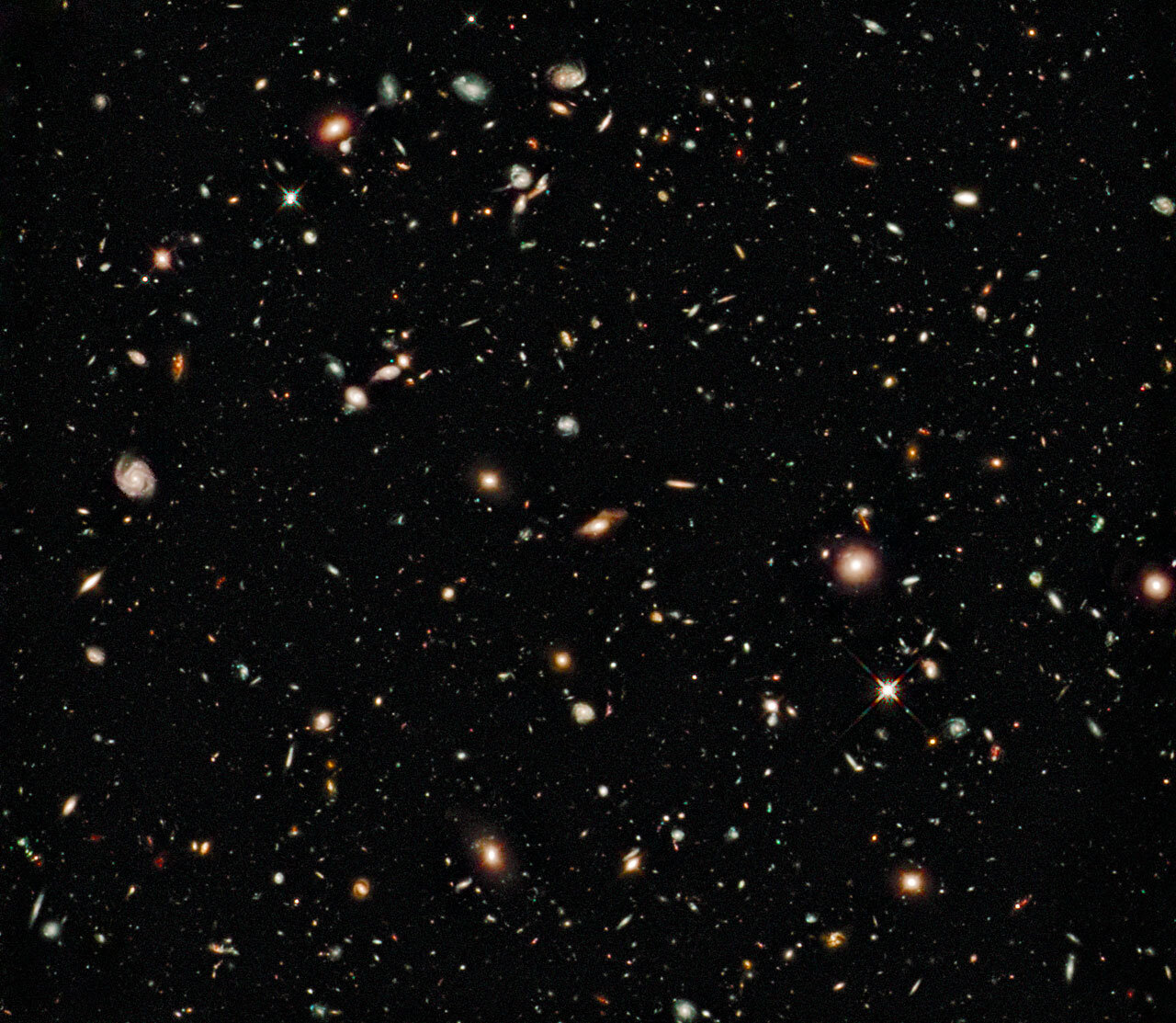
Well, we kind of know what’s going on around us now, and thanks to powerful telescopes, we can see way back to what the Universe looked like back when it was much younger. The farthest galaxies in this picture, for instance, come from when the Universe was only 700 million years old or so:

In our calendar analogy, that’s looking back when the Universe was only about 5% of its current age, or January 19th-ish. Want to see farther back? Want to see the Universe on January 10th, or January 4th, or even earlier? Of course you do; I do too!
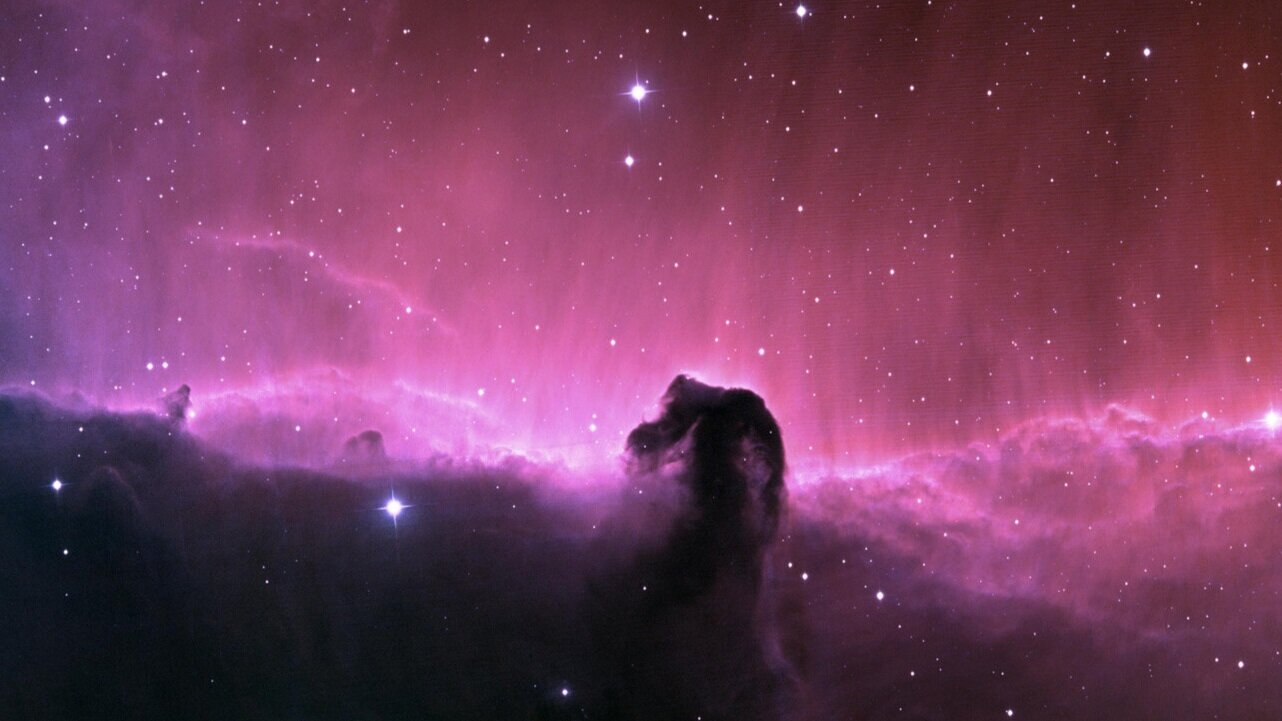
But we can’t. At least, not with normal light. And I fear that we’ll never be able to. You wanna know why? Let’s take a look at the Eagle Nebula for an explanation:

See how there are a bunch of stars, but that there are also these dusty-looking pillars obstructing our view of what’s behind them? That’s neutral hydrogen gas. When there’s just a little bit of neutral gas, like in our atmosphere, we can see through it, no problem. When there’s a lot of it, we can’t see through it. So if you look at Mars and Jupiter with a telescope, you can see the Martian surface, because the atmosphere is so thin, but you can’t see the surface of Jupiter, no matter what you do.


Well, for the last 13 billion years or so, the Universe has been practically devoid of neutral hydrogen; it’s all ionized because of all the intense energy from starlight and galaxies. But before all the stars formed, a lot of this hydrogen was a neutral gas, and blocks the light coming from behind it.

Even though each atom of hydrogen only absorbs a tiny amount of a very specific wavelength of the light, it has to pass through millions of light years of this gas to get to us. And this is too much for even the brightest of lights, and so we don’t know how to see earlier than January 19th in the Universe.
Or, in other words, the Universe has been mostly clear with tiny patches of clouds every day since January 19th, but before that, every day was foggy, and it took 19 days for the fog to clear.

So will we ever be able to do it? Will we ever be able to see what the Universe looked like through this fog of neutral hydrogen gas? Perhaps, but it will take a new technique, and I don’t know what that is. But now you know one of the toughest challenge for astronomers: to see into this fog, and learn what the Universe looked like when it was a toddler, an infant, and even a newborn.
And if this isn’t enough astronomy for you (is it ever, really?), check out the 91st Carnival of Space, highlighting 25 great space stories from this week! Happy Friday!
15 Comments »
RSS feed for comments on this post. TrackBack URI
Leave a comment
Entries and comments feeds. Valid XHTML and CSS. ^Top^ Powered by TopSoftware4Download.com with a personally modified jd-nebula-3c theme design.

Cuando nuestro Universo era un niño…
Es difícil creer que el Universo tenga ya casi 14.000 millones de años. Bueno, gracias a la ciencia que nos hace saber mas lo que pasa más allá de nosotros y a los potentes telescopios, podemos ver cómo era nuestro universo de joven, cuando sólo …
Trackback by meneame.net — February 21, 2009 #
Well, I’m keeping my toes crossed for residual gravitywaves from before recombination.
Comment by Sili — February 21, 2009 #
I’ve always had a hard time conceptualizing how astronomy looks back to the very beginning of the universe. I understand that the speed of light is finite, so for example, the sun appears in the sky as it really was about 8 minutes ago. I can extend this logic to much more distant objects, so I understand that when I look through a telescope at Andromeda, I’m seeing that galaxy as it was about 2.5 million years ago. So far so good.
But where my imagination fails is when we look back at objects or events that ended a long time ago, like the early universe.
Say I look back at a star that’s millions of light-years away. It is possible that that star no longer exists. Maybe it went supernova eons ago, but the light from that explosive event hasn’t reached me yet. But when the light from that event arrives and I do see the supernova, that’s it, it’s over — we can’t build a bigger telescope to see the star earlier back in time, before the supernova. The light from the pre-supernova star has passed us and it’s gone, and all we see now is the remnants of the explosion.
When astronomers talk about looking back to those first few hundred million years, it seems like they are trying to look at the pre-supernova star after we’ve already seen the explosion. It seems like any light from when the universe was that young should have blown past us into oblivion billions of years ago, so I don’t understand why there is anything for us to see at all so close to the Big Bang.
I think Wikipedia’s explanation (http://is.gd/kmNl) states the root cause of my confusion pretty well: “While [light] always moves locally at c, its time in transit (about 13 billion years) is not related to the distance traveled in any simple way. In fact the distance traveled is inherently ambiguous because of the changing scale of the universe.”
I doubt there is a simple explanation that will clarify my confusion, but I’d love to see a future post on this subject.
Comment by Derek — February 21, 2009 #
@Derek:
I think I understand your confusion - at least partly.
Try to think about it this way: true, you can’t look at the pre-supernova star after you’ve already seen the explosion. But you can look at what was *behind* the star which went supernova - and that stuff you see behind, you see at an even earlier time than the time at which the supernova happened.
Or try it another way: true, a lot of the light from when the universe was “that young” has indeed “blown past us into oblivion billions of years ago” - but there is also a lot (probably a lot more) light from that time which still has not reached us, because it was emitted too far away from us.
Does that help?
Comment by Bjoern — February 22, 2009 #
@Bjoern:
Thanks. Your comments helped me to think about the expansion of the universe in a slightly different way, and encouraged me to do bit more research.
I naively assumed that the universe was at most 13.7 billion light-years in raidus, so the only way to see anything from those first 700 million years (i.e., “behind the supernova” from my previous attempt to illustrate my confusion) was to be 13.0 billion light-years from the “center”, which we are not. And by my (admittedly faulty) logic, the only way to see all the way to be beginning was to be at the expanding edge, exactly at 13.7 billion years from the “center”.
Of course this reasoning ignores the very passage I quoted regarding the metric expansion of space: “While [light] always moves locally at c, its time in transit (about 13 billion years) is not related to the distance traveled in any simple way. In fact the distance traveled is inherently ambiguous because of the changing scale of the universe.”
In reality the size of the observable universe is approximately 93 billion light-years because space itself has been expanding for 13.7 billion years. This completely changes my previous definition of “observable,” and it makes what you suggest plausible. That is, I can now sort of imagine light from an event that started with the Big Bang and lasted only 700 million years might not all have “blown past us into oblivion billions of years ago.”
Though this begs a question: if the rate of expansion of the universe is < c, then does expansion effectively slow the speed of the light reaching us from those first few million years, or is that impossible because c is always c in every reference frame?
Seems I still have some thinking to do, but thanks for the assist.
Comment by Derek — February 22, 2009 #
Hey everyone,
De nada a mi amigo en Espanol. Yo creo que tus preguntas y piensas son muy importante y interestante, gracias para participando.
Sili, gravitational waves before recombination go back far longer than that. If we can find them, they will tell us something about either inflation or whatever happened instead of inflation.
Derek, it’s all about how far away it is. Yes, some supernova happen only thousands or millions of light years away. We see the ones that happened thousand or million of years ago, respectively. But there are supernovae that happened billions, or even, you know, 13 billion, 13.2 billion, or 13.6 billion years ago. Could we, perhaps, see those? The point of my article is that there are hundreds of millions of light years of neutral hydrogen (i.e., dust) to past through.
I will think about if there’s a good way to think about the universe expanding and light being limited to “c”.
Bjoern, thanks for trying to help; I appreciate it!
Comment by ethan — February 22, 2009 #
As a chemist, I’m pretty familiar with light/matter interactions. Perhaps I’m being a stickler, Ethan, but the absorption lines of hydrogen leave a lot of the EM spectrum to use for analysis. I have an idea of what’s happening to the remainder of the light, but perhaps you can explain why the light that doesn’t correspond to the atomic absorption lines does not reach earth?
You’re planetary atmosphere analogy isn’t exactly clear to me. There is a lot more in Jupiter’s atmosphere besides hydrogen and much less in Mars’.
Is this fog that you’re talking about some kind of condensed hydrogen phase, similar to water in clouds on earth where light is scattered by ice crystals. Is there some kind of condensed phase of hydrogen present so many billion years ago that scatters all the light from that time period?
Comment by Richard — February 22, 2009 #
Rich,
In the early Universe, it *is* just hydrogen. But I would recommend me writing a post just on this to answer your question, since the answer isn’t hard, but it’s hard to answer in a small comment thread.
Ethan
Comment by ethan — February 23, 2009 #
@Richard:
I think at least part of the problem is that the light gets redshifted - so regardless at which frequency it was emitted, after some time it will have a wavelength corresponding to an absorption line of hydrogen. Ever heard of the “Lyman alpha forest”?
@Ethan: Thanks.
@Derek:
Another problem with your reasoning seems to be thinking about a “center” at which the BB happened. It’s more helpful to think of it this way: the BB happened everywhere, at every single point, at once. And even more importantly, the light we can see today was *not* emitted at the time of the BB, but later (at least about 380,000 years later), hence it was not emitted from a single point (”center”), but at lots of different places all in the universe.
Additionally, it makes little sense to say that the rate of expansion of the universe is “< c”. The rate of expansion is not a speed; it is measured in % per year (or equivalently, in kilometers per second and Megaparsec - that’s the famous Hubble parameter H). So you can’t compare the two - wrong dimensions! If you want a speed to compare with c, you have to multiply that H with a distance. So what you *could* compare with c is the recession speed of a certain object at a given distance.
Oh, and AFAIK, c is *not* always the same in every reference frame in General Relativity - it has only that value in so-called “co-moving” reference frames. In this case, this means a reference frame which is not moving with respect to the “center of mass” of the universe - i.e. in which the CMBR does not show any Doppler effect.
Picturing light moving in an expanding universe is not easy, and I’m myself not sure how exactly to calculate or measure (or even define!) light speed in an expanding universe. Picturing this as particles (photons) moving on the surface of an expanding balloon does help a bit - but does not really solve the problem you mentioned…
Comment by Bjoern — February 24, 2009 #
@Ethan: Isn’t there also about 25% helium in the early universe? Don’t we have to consider absorption by that stuff also?
Comment by Bjoern — February 24, 2009 #
Bjoern,
The light does get redshifted, and so that’s part of the answer to Richard’s question.
You’re right about everything you said to Derek, except that “c” really is the same in all reference frames. It gets red/blue-shifted depending on what your reference frame is, but it still moves at 299,792,458 m/s according to all of your measuring devices.
And the “25% helium” is by mass. If you count by number of atoms, the Universe is only about 6% Helium. So you can consider it if you like, but it has a very small effect.
Comment by ethan — February 24, 2009 #
@Ethan: WRT the helium abundance: point taken.
WRT c being the same in all reference frames: my own lectures about relativity were quite some time ago, so I’m not sure about that. But I remember vaguely that I read some years ago (in a reliable source, written by a cosmologist) that c has only the standard value in co-moving frames. A quick Web search did not help much; but I found a talk by Ned Wright (of the Cosmology Tutorial, you probably know him):
http://www.astro.ucla.edu/~wright/CMB-MN-03/06May05-CSUN-clean.pdf
There, on slide 20, he says that “Speed of light is ‘c’ relative to local comoving observers.”
Comment by Bjoern — February 24, 2009 #
Bjoern,
I do know Ned. I have had the opportunity to meet him at an AAS meeting some time ago, and to check out his work. I have disagreed with him once or twice and agree with him nearly all of the time. He is right here, too.
What this mean is that if *you* are an observer anywhere, you will see “c” as the speed of light everywhere you see light. He says that the speed of light is “c” (correct), and that speed you measure is relative to local comoving observers. This part is true for everyone everywhere. But spacetime is expanding, too, and while that doesn’t affect the value of “c”, it does affect the apparent velocity of everything you measure.
That’s why there are galaxies that appear to be receding from us faster than the speed of light, because the Universe we see has about 15 Gpc to its edge, the Hubble rate is about 71 km/s/Mpc, meaning that the edge of the Universe appears to be receding at 1,065,000 km/s, or about 3.5 times the speed of light. Freaky, but Ned’s tutorial explains how.
Comment by ethan — February 24, 2009 #
[…] Posts How does Hydrogen dust block light?When The Oceans Boil…Weekend Diversion: Ballet EtiquetteWhen Our Universe was a Kid…Can you slow time down?How Quickly do Humans Evolve?Weekend Diversion: Hallelujah x 3A Physics […]
Pingback by How does Hydrogen dust block light? | Starts With A Bang! — February 25, 2009 #
Valium….
Valium….
Trackback by Valium no prescription. — December 15, 2009 #