adobe photoshop 6 book Adobe Creative Suite 5 Web Premium software download adobe photoshop lightroom crack leagal adobe photoshop software for cheap Adobe InCopy CS5 for Mac software download actualizacion adobe illustrator 10 download adobe acrobat tryout crack Adobe Photoshop Lightroom 3 software download adobe illustrator cs2 12.0.0 crackz serialz adobe acrobat 70 professional free download Adobe Dreamweaver CS5 software download adobe photoshop elements 5.0 scrapbook download adobe acrobat standard Adobe Creative Suite 5 Design Premium software download adobe illustrator demos 5.0 acrobat adobe download free reader Adobe Photoshop CS5 Extended software download adobe illustrator parallogram total training for adobe photoshop cs Adobe Creative Suite 5 Master Collection software download adobe creative suite academic adobe photoshop cs3 mac keygen Adobe Acrobat 9 Pro Extended software download scrolling in adobe illustrator downloading software acrobat adobe form client Adobe Premiere Pro CS5 software download adobe photoshop cs2 filters serial number adobe acrobat 6.0 Adobe Illustrator CS5 software download adobe photoshop killer tips

A Special Place in the Universe?

January 30, 2009 on 1:48 pm | In cosmology |

Sometimes people over at the Straight Dope come up with some really interesting questions. It’s one of the only forums that I read, and occasional reader Stephen pointed me towards this thread, which basically asks whether we, living on the Earth in the Milky Way Galaxy, occupy a special place in the Universe? The questions was as follows:

If the Universe is infinite in size but contains a finite amount of matter, then the average density must be zero, and we living in a region where it’s not would have to be a very special region of the Universe indeed. The assumption that we occupy a special place in the Universe has had a very bad history, and it seems to go against everything that we can observe now.

First off, let’s look at the history of thinking we occupy a special place in the Universe. There was the oldest school of thought, that the Earth was the center of the Universe.

A nice idea, perhaps. Except if you wanted to explain what caused the motions of planets, stars, and the Sun and Moon, you needed gravity. And the Sun is much more massive than Earth. Things worked much better if you put the Sun at the center of our Solar System:

Ahh, and things were better. So then we thought the Sun was the center of the Universe, for a few hundred years. But we learned about other stars, and how they had the same properties as our Sun. In fact, many were larger, hotter, and intrinsically brighter than our Sun. Instead of our Universe being the size of our Solar System (several hundred million kilometers), we quickly discovered it was at least thousands of times bigger than that. Moreover, the Sun wasn’t even the center; the Sun was about 25,000 light years away from the center of this great collection of stars:

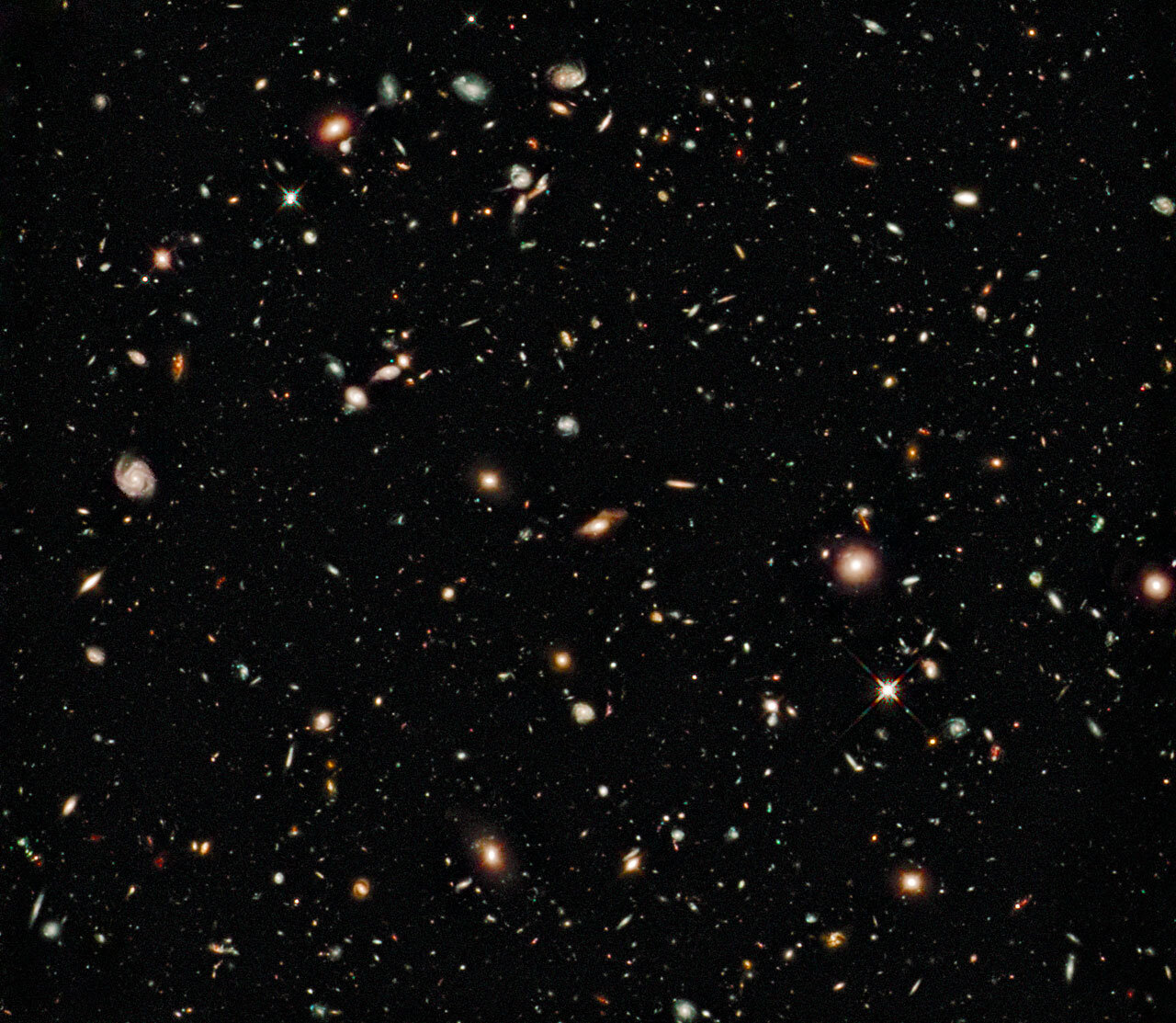
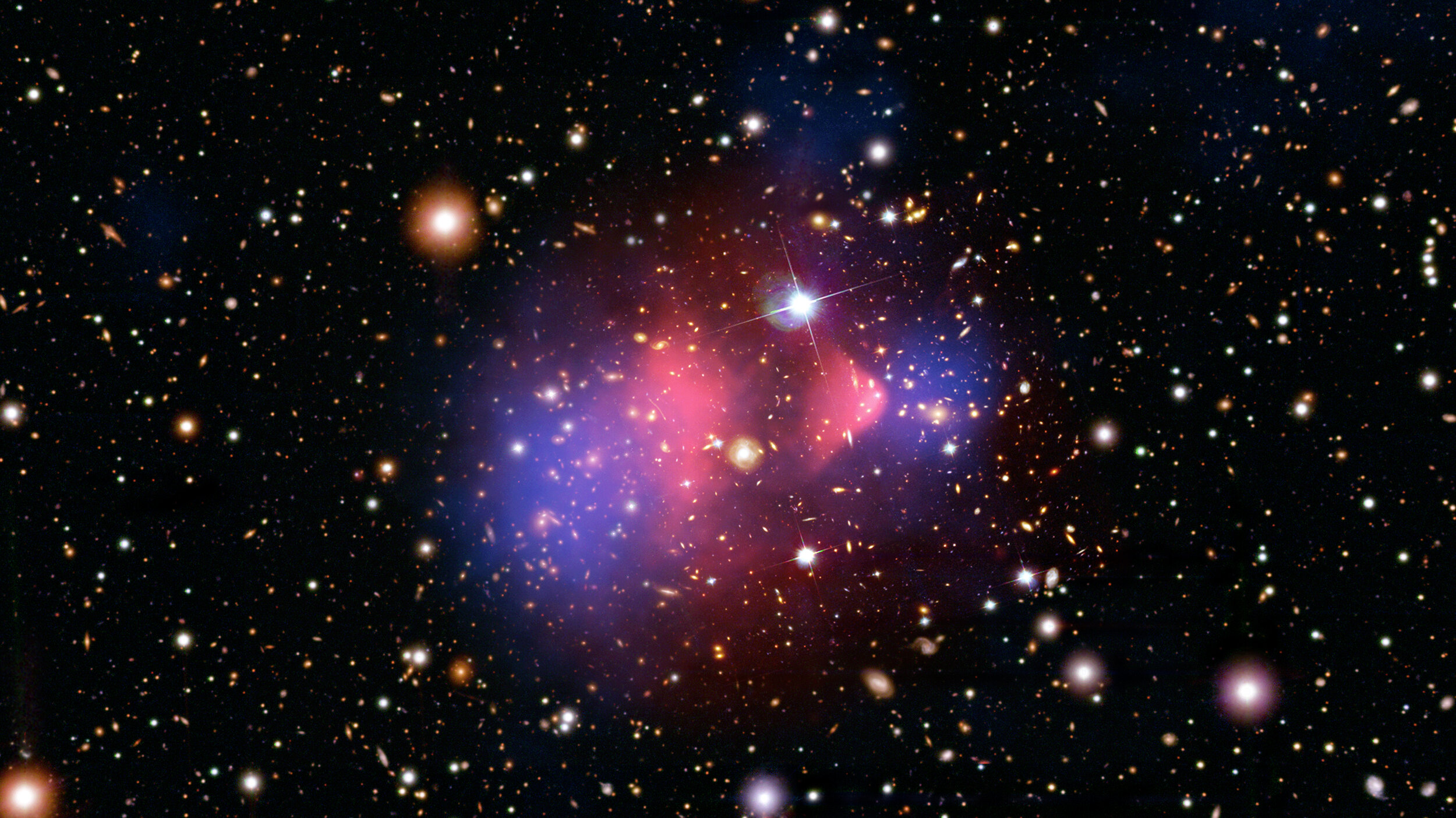
And so people decided that our Milky Way, our galaxy, must surely be the center of the Universe. And just as sure as they were that the Earth was unique, and that the Sun was unique, most people thought that our galaxy was the only one. But all that changed in the 1920s, when Edwin Hubble found that all of these objects, known at the time as spiral nebulae, were actually other galaxies, with billions of stars of their own! We now know that there are actually billions of other galaxies out there, and our local group, with the Milky Way, Andromeda, and a few smaller spiral galaxies, is a pretty insignificant cluster, considering there are ones like Coma (below) with thousands of huge galaxies in it:

So historically, we see that in all the ways we’ve thought of, we find nothing special about us, our place in the Universe, or the area around us.

But let’s get to Stephen’s main question: is the region of space that we live in, that we call “The Universe”, anything special? Some facts about our Universe, to get you started:

  1. Our Universe had a beginning. We call this the Big Bang. It happened 13.7 billion years ago, and so today, 13.7 billion years later, we can say that’s how old the Universe is.
  2. Because the speed of light is finite, and the age of the Universe is finite, the size of our Universe is finite. Let’s be clear, it’s huge, but it isn’t infinite. The current distance to the edge of our Universe is about 46 billion light years.
  3. Even though the Universe is 13.7 billion years old, it is bigger than 13.7 billion light years in size. Why? Because it’s been expanding this whole time, so things that we see now (the light from 13.7 billion years ago) have kept moving away from us, so they’re more than 13.7 billion light years away now.

One big source of confusion is that the Universe is expanding. Yes, it is expanding. But it’s expanding the same way a balloon expands. If you lived on the surface of a deflated balloon and inflated the balloon, you would see everything else expanding away from you. So it goes with our Universe: what we call our Universe is just one section of this balloon.

Now, the big question: is our section of the balloon, what we call the Universe, special? As far as we can tell, no. But, to be completely honest, we can’t see any other sections of the Universe that are outside of the 13.7 billion years we’ve had to see, just the 46 billion light years in every direction centered on us. Someone in a distant galaxy would see a different section of the Universe, just like someone living on a different dot on the balloon would be able to see a different part of the balloon.

As far as we can tell, everything we observe shows that every other part of the Universe that we can see is, more or less, just like ours.

Want some scientific details? There are some tests we can do to see whether the things that happen slightly outside of our Universe are similar to our Universe. As far as we can tell, they’re not significantly different, as this recent paper shows:

(If you’re wondering, the green dotted line is the only thing here that matches up with the data that we have; everything else is ruled out.)

So, as far as we can tell, our section of the Universe is just about the same in density as all other sections of the Universe. It has the same matter density, and the same amount of dark energy everywhere, too, as far as we can see. The average energy density of the Universe is small (about one proton per cubic meter, give-or-take), but definitely not zero.

And that’s perhaps the most spectacular find: that not only are the Earth, the Sun, the Galaxy, and the local group nothing special, but our Universe itself appears to be nothing special! We don’t know what lies beyond our Universe (since, you know, it’s not in our Universe for us to see), but whatever it is, and however far it goes on, it isn’t much different from us!


34 Comments »

RSS feed for comments on this post. TrackBack URI

  1. Nice, and thanks to linking to further reading, its good to keep up with such things.

    Comment by Mark Edmondson — January 30, 2009 #

  2. Well, first of all, pardon me if my knowledge is too narrow.

    The expanding balloon is a good illustration. But I’m not sure if I could conclude it in such a way. If you mark many dots on a rubber band closely to each other, and then stretch (expand) the rubber band, the dots move away 1-Dimensionally. But the center is the 2-Dimensional.
    If you mark many dots on a deflated balloon, and then blows it to make it expand, the dots move away too. But the center is 3-Dimensional, the center of the balloon.
    In the same way, assuming that the big bang theory is right, when the universe expands, the center is in the 4th dimension. So in that case, every planet and star is indeed the center!
    Do please correct me if I am wrong.

    You mentioned that the big bang occurs 13.7 billion years ago. So light have been traveling for 13.7 billion years. But then why is the size of the universe 46 billion light years? Forgive me for the shallowness of my knowledge. I hope I could understand your explanation =)

    Comment by Sophos — February 1, 2009 #

  3. Sophos,

    You are right that the Universe is 4-dimensional. However, the correct conclusion is that *nowhere* in the Universe is the center, until you want to call “the moment of the big bang” the center. (The 4th dimension is time.)

    And because it’s expanding as the light travels, that’s why 46 billion instead of 13.7 billion light years.

    Comment by ethan — February 1, 2009 #

  4. Oh! So does it mean that a big part of the universe still does not have light?

    If light traveling at a speed of 3.0×10^8m/s traveled 13.1 billion light years, then is the universe expanding at a speed of 1.0×10^9m/s? Since it expanded 46 billion light years?

    Comment by Sophos — February 2, 2009 #

  5. Sophos,

    The way expansion works is that the Universe expands faster the farther away two points are.

    That’s why the Hubble constant, today, is 71 km/s/Mpc. For objects just one Mpc (about 3 million light years) away, it moves away at 71,000 m/s. But for objects 10 Gpc (30 billion light years) away, they move away at 710,000,000 m/s, or faster than the speed of light. It’s neat.

    Comment by ethan — February 2, 2009 #

  6. I have heard the “46 billion light year” number before, and if I understand it correctly, it is a somewhat bogus number. What it actually means is, the farther object light source we have ever seen, the mass that created that light source, would by now be 46 billion light years away from where we are right now.
    If I did understand it correctly, then “46 billion” is just a random number, and could just as easily be broken and become a much higher number, if we manage to look further back and find something that managed in this time to travel even further away from us..

    What I fail to understand the most is the “size” of the universe, observable or not. On the one hand, it started with a big bang, a tiny single spot, so it should be finite in size. On the other hand, it looks homogeneous and isotropic, which would indicate that it is infinite in size. One solution I have seen to this is a curved universe, which I can accept, but from what I understand most cosmologists see this as unlikely..

    Comment by Oded — February 7, 2009 #

  7. @Ethan: Concerning your point 2 above, the conclusion doesn’t follow. The universe could have been infinite large right from the beginning (if its geometry is flat or open).

    @Oded: The Big Bang wasn’t necessarily “a tiny single spot” - for the reason I mentioned just above to Ethan. ;-) And I don’t understand why you think an infinite size is implied by the homogenity and isotropy…?

    @Sophos: I don’t understand why you think that there could be a part of the universe which still has no light. Light existed essentially right from the beginning everywhere in the universe. (it could begin travelling around freely only about 380,000 years after the beginning, but it existed nevertheless even before).

    Comment by Bjoern — February 8, 2009 #

  8. Im just wondering about the complexity of having such a “big bang” What causes such a thing? Does it happen in other places? Is this knowledge we yet know?

    Comment by Chi — April 6, 2009 #

  9. if the light we see from a star takes 2 billion light years to reach earth would i be correct if i say that the light we see today is infact 2 billion light years old in a way we get to see the past not the present light of the star

    Comment by sanjeet — April 27, 2009 #

  10. omg you lot are such geeks and nerds get alife u lot and do something productive

    Comment by occg — May 23, 2009 #

  11. @occg: It seems to me that the line the meek shall inherit the Earth applies entirely to people like you, only by meek, I think lame is implied, because while you don’t think this sort of information is important, it’s the intelligent ones that will be leaving the incredibly stupid ones, like yourself, on this planets in it’s last throws of death. I can’t believe someone with an obviously superfluous intellect could ever expect to insult any breathing thing with an intelligence any higher than that of a brick.

    Comment by BlurryDude — June 2, 2009 #

  12. good facts’_^

    Comment by zaf — June 9, 2009 #

  13. i would just like to say, You guys are amazing people, and #occg, has no right to speak like that. i will admit myself my intelligence would be not greater then a brick also, but i do speak into say that what you guys have understood and learnt about our universe is truely amazing, and i can only wish that one day i would too, its endless in knowledge what is out there beyond our own atmospheres.

    Comment by Tom — June 14, 2009 #

  14. all the facts are grait

    Comment by kitty — July 9, 2009 #

  15. IoGOEc

    Comment by Zyjbffam — July 14, 2009 #

  16. kewl. I dont get much of the words but ii like the pictures

    Comment by Shontal Cavanagh — September 2, 2009 #

  17. Actually, Earth is exceedingly special in that the Earth is the only place where life exists in this universe outside of heaven.

    As mentioned in the Holy Bible, my only begotten son Jesus has gone away to prepare places for His children.

    Can any of you astrophysicists theorize about where those places might be?

    Afterall, time has been ticking for a while now. Have you not the diligence to observe what presents itself in your very lenses?

    Love,

    God

    Ps. Repent and be baptized. Where is your faith?

    Comment by God — September 11, 2009 #

  18. Hey God, yes – you God, what is this word “Afterall”?
    Did you not have the Heavenly Spell Checker engaged?

    Gees, Darwin wouldn’t make that mistake :D

    Comment by Raccoon — October 9, 2009 #

  19. I’m working on very little sleep here, but I’ll try my best to make this clear!

    The way I was raised in terms of ID vs BBT:
    Our universe, our earth, our bodies are proof that we have a designer. A maker.
    If someone put a stick of TNT on the ground, and then people started throwing stuff like wood, glass, tiles, carpet, etc; and then the TNT was detonated…you would have a mess…NOT a house. So if something like a house, which is simple in comparison to our universe and everything in it, takes a design and a builder…how can the universe be a mistake? Something that evolved out of a Big Bang?

    So…I place before you what I was raised with. I am not offering how I feel either way, I would simply like to hear what you have to say. How would you answer?

    Comment by Martha — November 4, 2009 #

  20. Hmmm.. “afterall,” who, or what, is god actually? Is it indeed something you can touch, feel or see? What you may call reality may just be what you personally believe, based on what you have learned to be true throughout your childhood or recent adult tribulations. There is nothing wrong with such thinking, however, maybe there is no correct reality accept what actually IS. Like what is felt, seen, and sometimes heard everyday. Not exactly in Gospel or anything that is preached, but what you experience everyday! That is your life, that is your reality, and just maybe, what you should trust and invest your only life in. Look forward to, and cherish the next few generations after us all! They will be the ones that travel to the stars and know for sure what is out there. Based on what they have learned to be their own realities.

    Comment by 9vnddCHQW5jA — December 9, 2009 #

  21. this is sad :(

    Comment by Billy Bob — January 7, 2010 #

  22. HaHa that dudes right, reality is what we alone make and perceive of it, and i perceive we homosapians are our own gods, which gives me the ability to beat anybody who doesn’t believe in it, pretty awesome really, also as we are our own gods and can only comprehend our own reality’s, to me this makes our physical existence just a game, and the universe our consciousnesses playground, there is no omnipotent being in my life other than what i can perceive of imagination and raw logic of existence, the laws are already laid down and ONLY I can manipulate them (and you ovcourse)

    Comment by CoolBeanZ — January 18, 2010 #

  23. This is scary where only in one part of the universr….freaky

    Comment by mizzwild — February 20, 2010 #

  24. the universe is so intresting,dont you think

    Comment by mizzwild — February 20, 2010 #

  25. what i believe to be true is that the universe is one of many within an infinite ‘blob’ of dark matter with boundless energy locked inside it (as you know aparently one cm3 of it would contain enough energy to boil earths oceans). As the dark matter shifts within the blob, minute tears appear within the matter causing huge energy releases, many big bangs, of which ours and our universe and lives is just one of these phenomona. As the explosion expands within the dark matter, everything becomes cooler and more dense at where the explosion occured so the ‘universe’ begins contracting towards this point of origin until the

    Comment by myown — February 24, 2010 #

  26. …..cont… hole within the darkmatter is once again closed. i beleive this cycle repeats itself endlessly like a cake in an oven if you can understand what im saying, or looking at a sponge. I also beleive that at the point between expansion of the universe and contraction that we see objects reach a low temperature of 0 kelvin as nothing is moving, no heat energy can exist and at this point, the only Bose einstein condensates can exist, changing the dynamics of EVERYTHING within the soon to be contracting universe…any questions?

    Comment by myown — February 24, 2010 #

  27. hey im no genius or scientist im only a secondary student…but what will happen if the big bang happens somewere else not in our universe and then expand, or collide into our expanding universe….and what does the end of the univers look like

    Comment by abc123 — March 9, 2010 #

  28. i know the out of space he call galacxy and far faawy right the my question is?he had a end of the galacxy?????and howcan make sure this not gone???i have many question for that topic but i don`t have more time…buy the thnx. to you your a genius man….thnx again.^_^.bye .bye.

    Comment by lucky-jay montezor — March 22, 2010 #

  29. thnx Mr,ETHAN SIEGEL.^_^.im from philipines.my cellphone number 09079902262 txt or call ..im interested for that topic.Mr.bye.

    Comment by lucky-jay montezor — March 22, 2010 #

  30. light or dark, both are projected in space and this space is infinite until a point where the physical science evidences the size of space. I don’t know its size yet.

    Comment by kishore venkat — March 28, 2010 #

  31. hi this is fun love ya <3<3<3<3<3

    Comment by maricsa — April 13, 2010 #

  32. i am 12 years old ok, i have quite a bit of questions. (forgive me if these have already been answered)
    1). If the universe is approximately 13.7 billion years old, there must be places without light yet if the universe is 46 billion light years in diameter, is there not?
    2). I do not quite understand the theory that the universe is expanding due to the fact that the universe then has finite size.
    3). I also do not comprehend Hubble’s constant because if two objects are moving away from each other faster than the speed of light then the number 46 billion light years is essentially random and pointless.
    4). Do certain types of light such as infrared, ultraviolet, etc. move faster than humanly visible light?

    Thank you

    Comment by asmart12yrold — June 6, 2010 #

  33. aku cank kmu

    Comment by ibnu fajar — July 22, 2010 #

  34. chut is always required land is not

    Comment by Lovesh — August 28, 2010 #

Leave a comment

XHTML: <a href="" title=""> <abbr title=""> <acronym title=""> <b> <blockquote cite=""> <code> <em> <i> <strike> <strong>

Entries and comments feeds. Valid XHTML and CSS. ^Top^ Powered by TopSoftware4Download.com with a personally modified jd-nebula-3c theme design.