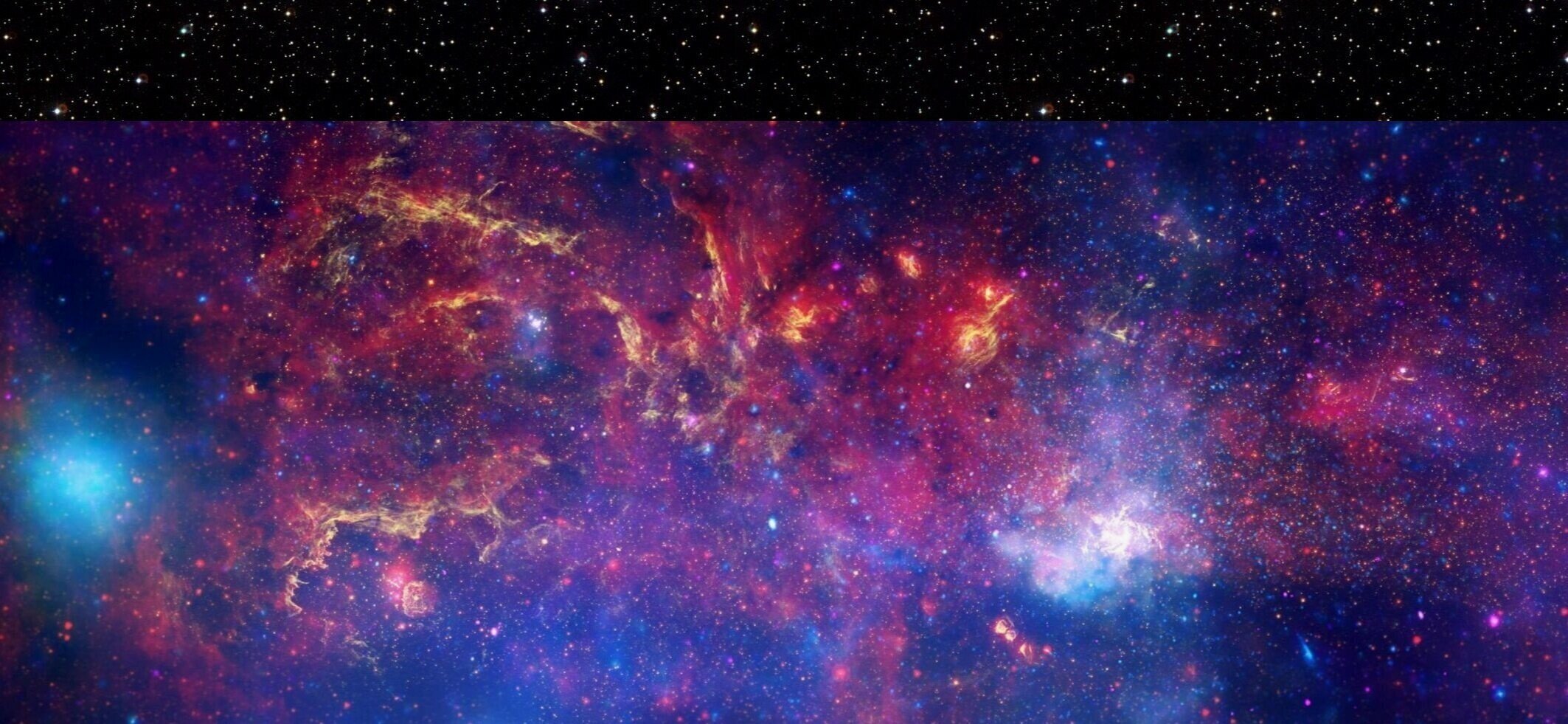
Whose Stars Are These?
October 27, 2008 on 1:19 pm | In Astronomy, Q & A |
When you look up at the night sky, one of the first things you learn is that every point of light you see is either a star or a planet:

But what happens if you look through a pair of binoculars? Well, suddenly, you can see a lot more stars than you used to. Because it focuses light coming from a larger region of the sky into your eyes, it lets you see fainter objects. Instead of just about 3,000 stars, binoculars let you see over 100,000 stars! A part of the night sky would look like this instead:

But our technology doesn’t stop at binoculars; we’ve build telescopes, both large and small, that have incredible amounts of light-gathering power! The unaided human eye is about 100 times less powerful than a pair of binoculars, and a small telescope (about 6-8″) is another 100 times more powerful than binoculars are. When you start to use small telescopes, you can see details that are impossible with simple binoculars. Take a look (and click here for the full image):

This is just a picture taken by an amateur astronomer of a comet (the green thing, Tuttle 8P) that happens to be passing by a nearby galaxy (M33, the diffuse thing). And we can see that not everything is a star after all.
But our reader Greg is very savvy, and knows what really powerful telescopes can see.
He asks the following:
Approximately how many of the stars in a picture such as this are in our Milky Way galaxy, and how many are outside our galaxy just floating in space? Is it possible to see individual stars in other galaxies such as Andromeda?
In reality, the largest and most powerful telescopes can see objects that are anywhere between 10,000 and 1,000,000 times fainter than what a small, amateur telescope can see. Let’s take a look at Greg’s picture:

Now there are a bunch of stars in that image, but how do we know which ones belong to our galaxy and which ones belong to Andromeda, which is the closest large galaxy to us? This is a question with an easy answer: they’re all ours! While we can resolve individual stars sometimes in Andromeda, such as Cepheid variable stars, they don’t show up in a normal telescope image like this. How do we know? Let’s take a very similar galaxy to both ourselves and Andromeda, but the only difference is that it’s about 6 times farther away. This is the Sculptor Galaxy:

Notice how it looks very similar to the Andromeda Galaxy, except with far fewer star-like speckles? That’s because all the stars are here, in our own galaxy!
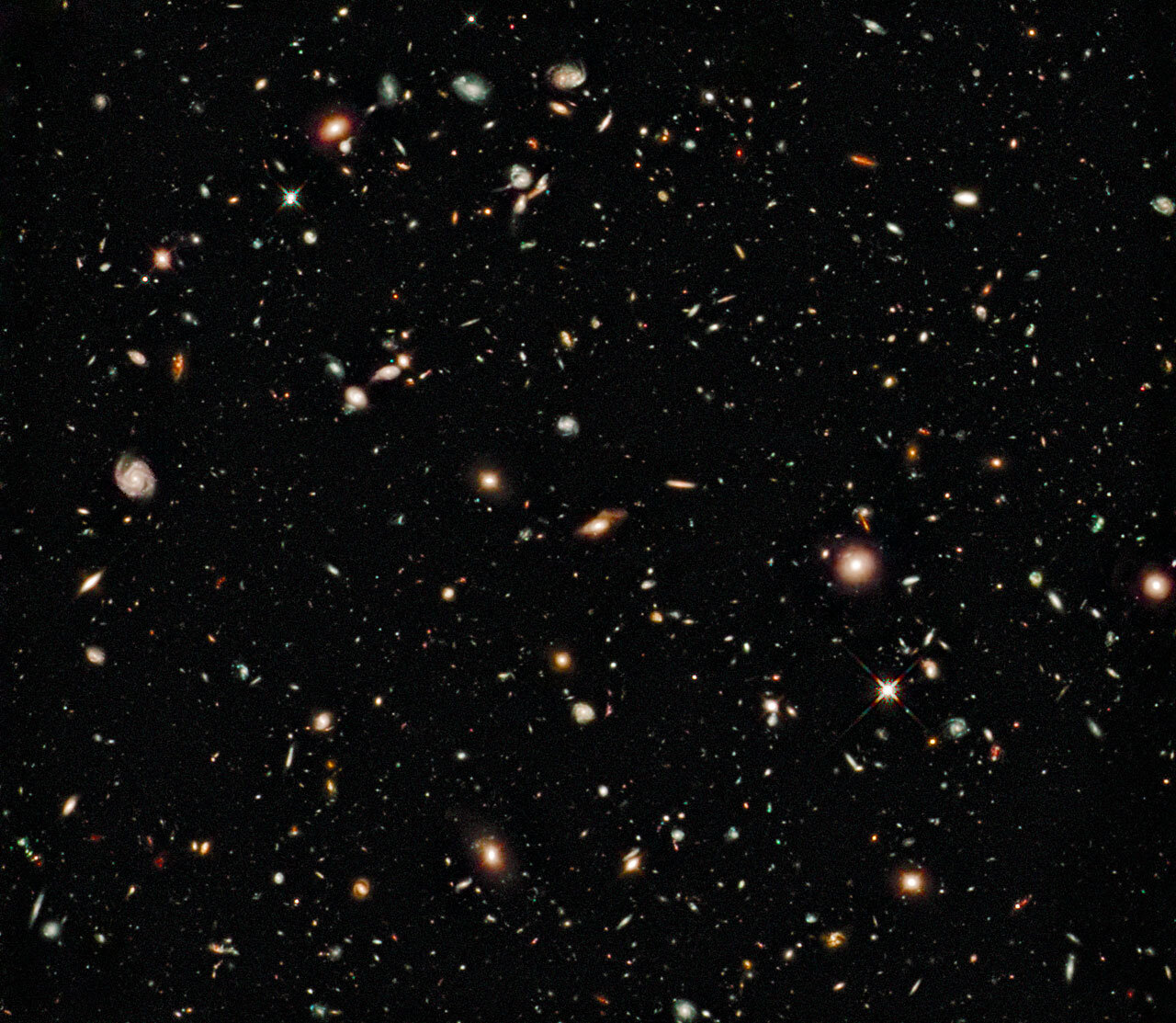
Want to take an extreme case? The Hubble Deep Field and Hubble Ultra-Deep Field images were made by pointing the telescope at a patch of sky known for being completely dark; having no known stars in them. You just sit there and point your telescope there, overexposing the image, and finding what turns up. The results look like this:

But the amazing thing is that every speck of light there is a galaxy; there are no stars in this image. So if we want, we can zoom in on a large, bright galaxy as best we can and see what it looks like:

Notice the absence of individual stars? It’s because they’re all in our galaxy. In fact, if we take that ultra-powerful Hubble Space Telescope and point it, say, at the sculptor galaxy above, we can see some individual stars. But they’re so faint and so miniscule compared to the stars in our galaxy that they get dwarfed. Take a look at the image below: note the foreground star in our galaxy (halfway down, about 1/5 of the way from the left border) and all the other stars, which belong to NGC 253 (sculptor’s scientific name):

See what I mean? They’re all our stars. Looking out at the Universe means looking out through our galaxy, and unbelievably, even in outer space, our own neighborhood gets in the way!
Good question, Greg, and I hope I answered it well for you!
32 Comments »
RSS feed for comments on this post. TrackBack URI
Leave a comment
Entries and comments feeds. Valid XHTML and CSS. ^Top^ Powered by TopSoftware4Download.com with a personally modified jd-nebula-3c theme design.

its nice
Comment by harikrishnan — October 29, 2008 #
Good website it helped me alot to understand why I can sometimes see bright things in the sky and to be honest I just thought they were bright stars but now I know that I have been seeing planets in the nights sky.Thanks for making this website because if you hadnt have made it I wouldnt have known what it was what I was seeing!
Comment by Shannon — February 9, 2009 #
thank you sir, very informative
Comment by hellraider — April 26, 2010 #
My dad gave me a Bushnell Binoculars and they are quite superb, excellent optics and very nice zoom. i could watch sexy babes from several hundred meters.`;’
Comment by Ellie Hughes — May 12, 2010 #
Dear Sir/Madam,
My name is Matthew Payne and I am emailing on behalf of the Global White Lion Protection Trust (GWLT).
I am a full time primary school teacher and I have been asked by the trust to develop educational resources, which teachers can download and teach in lessons. I am hoping this will help raise awareness about the White Lions in primary schools, throughout the UK.
In one of powerpoints which accompany the plans, I hope to use an image of yours which I have attached the link for as a background in my power points. The image really adds alot to my resources. I am emailing you today to seek permission to do this. No money is being made from the plans, their aim is purely to raise awarenss among primary children.
http://startswithabang.com/?p=1057 (2nd pict down)
Thank you for taking the time to read this email and I hope to hear from you soon!
Many thanks
Comment by Matthew Payne — August 6, 2010 #
Hi
your site is excellent.
i enjoyed very much
i have a question about how to use my telescope’s engine
if you can help me i will thank you if you just mail me
Comment by sara — August 11, 2010 #
thank you. very good topic and site
Comment by mert berk — August 13, 2010 #
I am so amazed with the capabilites of the Hubble telescope. Makes you feel so small. Thanks so much for this very informative blog. I’m thinking about upgrading my current telescope. I love the idea of being able to see more.
Comment by Meghann — August 16, 2010 #
yo mama
Comment by kiara — February 13, 2011 #
yo mama is so babe-like
Comment by kiara — February 13, 2011 #
i got big tits
Comment by kiara — February 13, 2011 #
ME FUNNY ^^
Comment by kiara — February 13, 2011 #
me got big tits
Comment by kiara — February 13, 2011 #
[…] source. […]
Pingback by life lessons, part one. | my little celebration — February 16, 2011 #
[…] Whose Stars Are These? startswithabang.com […]
Pingback by Stars Pictures | AllGraphicsOnline.com — March 15, 2011 #
your site is awesome……….looks cool to eyes
Comment by angel — May 14, 2011 #
Some tips i have always told people today is that when evaluating a good on the net electronics store, there are a few issues that you have to think about. First and foremost, you should make sure to look for a reputable and reliable retail store that has picked up great opinions and classification from other individuals and market sector people. This will make certain you are getting along with a well-known store providing you with good program and support to the patrons. Thank you for sharing your thinking on this blog site.
Comment by Dominic Beamer — June 13, 2011 #
I don’t even know the way I finished up here, however I thought this post used to be great. I don’t understand who you are however certainly you’re going to a famous blogger should you aren’t already
Cheers!
Comment by Roulette — July 14, 2011 #
One of my favorite posts.
Comment by flavored coffee — August 8, 2011 #
Now i am grateful for the assistance and pray you really know what a great job you are always providing teaching the mediocre ones via your site.
Comment by Jonah Aughenbaugh — September 6, 2011 #
awesome site! and beutiful colors…
Comment by kittykat487 — February 12, 2012 #
man asheghe 3tare ham.in axa mano ta hadi erza kard.tnx
Comment by mahshad — March 14, 2012 #
You are awsome! I zoomed in to one of those night sky photos and identified the fetures of some stars and grouped them using Stellar Classification.
Comment by B May — May 17, 2012 #
planktime in you face on the 12th, doesn’t make sense if you get triple gills!
Comment by B May — October 12, 2012 #
20 cents
30 dollars
50 monies
100 years
G/t2=S/h10
Comment by B May — October 12, 2012 #
Its like you read my mind! You seem to know so much about this, like you
wrote the ebook in it or something. I believe that you just could
do with some p.c. to drive the message home a bit, however other than that, that
is excellent blog. A fantastic read. I will certainly be back.
Comment by Direct Deposit Cash Advance Loan — November 4, 2012 #
Are you saying that we haven’t seen a star outside or our galaxy? All the claims of biggest known star in the universe are actually only limited to our own galaxy?
Comment by Claude — February 11, 2013 #
Hello it’s me, I am also visiting this web site daily, this website is truly good and the visitors are really sharing nice thoughts.
Comment by http://www.bookofseven.com/blog/234266/pure-green-coffee-bean-extract-a-proven-science — August 6, 2013 #
leptin green coffee 1000…
Whose Stars Are These? | Starts With A Bang!…
Trackback by leptin green coffee 1000 — August 22, 2014 #
before and after weight loss…
Whose Stars Are These? | Starts With A Bang!…
Trackback by before and after weight loss — August 22, 2014 #
Thank you for the auspicious writeup. It actually used to be a leisure account it.
Look complex to more added agreeable from you! However, how could
we be in contact?
my blog :: Best alkaline water ionizer
Comment by Best alkaline water ionizer — October 18, 2014 #
This post offers clear idea designd for the new people of blogging, that
in fat how to do blogging and site-building.
Comment by cheap vacations to mexico — October 19, 2014 #